
What the Housing Ombudsman does, who can use it, how to complain and how to contact it, explained for council and housing association tenants. This free guide for council and housing association tenants in England is published by Council Repair Claims, a regulated claims management company, not a law firm.
The Housing Ombudsman: A Tenant's Guide

Free, independent help when your council or housing association will not put things right
If your council or housing association has left repairs undone, or ignored your complaints, you don't have to put up with it. The Housing Ombudsman is a free, independent service that looks at complaints about social landlords and can order them to put things right.
This guide explains what the Ombudsman does, who can use it, what you need to do first and how to contact it. If you rent in Wales, different bodies handle complaints. See our guide to Housing Disrepair in Wales.
Key Points
- The Housing Ombudsman is free for residents and independent of both tenants and landlords. It handles complaints about social landlords in England, such as councils and housing associations
- You normally need to complete your landlord's own complaints process first. The Ombudsman needs your landlord's final (Stage 2) response before it can help
- You generally have 12 months from your landlord's final response to bring your complaint to the Ombudsman
- If it finds your landlord got things wrong, it can order an apology, compensation, outstanding repairs, or a review of the landlord's policies
- The Ombudsman aims to complete investigations within its published service targets, although timescales vary depending on complexity
- It does not decide negligence or personal injury, and it will generally not look at issues that are the subject of court proceedings
If your landlord has ignored a repair you reported, it is worth finding out where you stand.
There is no charge for our assessment, and no obligation to continue.
What Is the Housing Ombudsman?
The Housing Ombudsman is a public body that resolves disputes between residents and their landlords. It is sponsored by the Ministry of Housing, Communities and Local Government, but it makes its decisions independently and impartially. It isn't on the tenant's side or the landlord's side. Its job is to look at the facts and decide whether your landlord acted fairly.
The Ombudsman works under rules called the Housing Ombudsman Scheme. A new version of the Scheme came into effect on 1 October 2026.
It also oversees how landlords handle complaints. Since April 2024, landlords have had a legal duty to follow its Complaint Handling Code, which sets out how quickly they must respond to you.
Who Can Complain to the Housing Ombudsman?
You can complain if you are, or have been, a resident of a landlord that is a member of the Housing Ombudsman Scheme. Councils and housing associations that are registered providers of social housing in England are normally members.
That includes:
- council and housing association tenants (secure, assured or assured shorthold tenancies)
- leaseholders and shared owners
- licensees
It does not usually cover:
- private renters, unless the landlord or letting agent has chosen to join the Scheme
- freeholders, even if you pay an estate or service charge
- lodgers, or family members who aren't named on the tenancy
If you live in Wales, complaints about social landlords go to the Public Services Ombudsman for Wales instead.
What Can the Housing Ombudsman Help With?
The Ombudsman looks at how your landlord has dealt with problems and with your complaint. Common examples include:
- repairs that haven't been done, or took too long
- damp and mould
- poor communication or broken promises
- complaints that were ignored, delayed or badly handled
- anti-social behaviour, and how the landlord responded
There are things it can't decide. It does not make findings on negligence, liability or discrimination. If your health has been affected by the condition of your home, the Ombudsman says that is usually better dealt with as a claim through the courts. It will also generally not look at matters that are the subject of court proceedings, or complaints about the level of your rent or service charge.
What Do You Need to Do First?
Before the Ombudsman can investigate, you normally need to complain to your landlord and go through its complaints process. Most landlords have two stages.
| Stage | What your landlord must do |
|---|---|
| Stage 1 | Acknowledge your complaint within 5 working days, then respond in writing within 10 working days of acknowledging it |
| Stage 2 (escalation) | Acknowledge within 5 working days, then respond in writing within 20 working days of acknowledging it |
The Ombudsman needs your landlord's Stage 2 response before it can help. You then generally have 12 months from that response to bring your complaint to the Ombudsman.
If your landlord doesn't respond in time, the Ombudsman can ask it to respond, and can issue a Complaint Handling Failure Notice. Keep copies of everything: letters, emails, photos, and a note of calls and visits.
Our guide How to Complain to Your Council or Housing Association About Repairs will explain how to make a complaint step by step once it is published.
What Happens When the Ombudsman Investigates?
The Ombudsman looks at the evidence from you and your landlord, then decides whether your landlord acted fairly. It can make a range of findings, including service failure, maladministration and severe maladministration.
If it finds your landlord got things wrong, it can order it to:
- apologise to you
- pay you compensation
- complete any outstanding repairs
- review its policies and procedures
Compensation is for things like distress, inconvenience and any financial loss you can prove. Our guide Housing Ombudsman Compensation will explain how it is worked out once it is published.
The Ombudsman aims to complete investigations within its published service targets, although actual timescales vary depending on complexity. If you disagree with the decision, you can ask for a review within 3 weeks.
Where complaints show wider problems at a landlord, the Ombudsman can also carry out a further investigation (often called a Paragraph 49 investigation). Read what its recent reports found in What the 2026 Maladministration Report Means for Tenants and the Housing Ombudsman Annual Review 2025-26.
Housing Ombudsman or a Disrepair Claim: What's the Difference?
A complaint to the Ombudsman and a legal housing disrepair claim are two different routes. The Ombudsman will generally not investigate matters that are the subject of court proceedings, and may decline matters that could reasonably be dealt with by the courts.
| Feature | Housing Ombudsman | Housing disrepair claim |
|---|---|---|
| What it looks at | How your landlord handled the problem and your complaint | Whether your landlord broke its legal duty to keep your home in repair |
| Cost | Free | Usually handled by a solicitor, who will explain their own terms and any charges before you agree to go ahead |
| What you need first | Your landlord's Stage 2 complaint response | A letter of claim to your landlord under a court-approved process |
| Can it order repairs? | Yes | Yes, through a court order |
| Health or personal injury | Not decided by the Ombudsman | Can be included |
For some tenants the Ombudsman is the right choice. For others, especially where disrepair is serious or has affected health, a legal claim may be more suitable. Our guide Housing Ombudsman or Disrepair Claim: Which Route Is Right for You? will compare them in detail once it is published, and What Is a Housing Disrepair Claim? explains the legal route.
How to Contact the Housing Ombudsman
Council Repair Claims is not the Housing Ombudsman and is not connected to it. These are the Ombudsman's own contact details.
Notice (November 2026): At the time of writing, the Ombudsman's online complaint form is temporarily unavailable following a third-party IT security incident. The Ombudsman asks new complainants to email info@housing-ombudsman.org.uk or call 0300 111 3000 instead.
| Contact | Details |
|---|---|
| Website | housing-ombudsman.org.uk |
| Online complaint form | Make a complaint online (the Ombudsman's preferred way to receive new complaints) |
| Phone | 0300 111 3000 |
| Opening hours | Monday, Tuesday, Wednesday and Friday 9am to 5pm; Thursday 9am to 3.30pm |
| Post | Housing Ombudsman Service, PO Box 1484, Unit D, Preston, PR2 0ET |
Normally, the Ombudsman does not accept new complaints by email (see the notice above for the current position). Live chat is also available during phone opening hours.
Our guide How to Take Your Complaint to the Housing Ombudsman will explain what to include and what evidence to send once it is published.
What to Do If Your Landlord Won't Fix Your Home
- Report the problem in writing. Tell your landlord what's wrong, keep a copy, and take dated photos.
- Make a formal complaint if the repair isn't done in a reasonable time. Go through Stage 1 and, if needed, Stage 2.
- Take your complaint to the Housing Ombudsman once you have the Stage 2 response. It's free.
- Get free advice if you're unsure of your options, from Citizens Advice or Shelter.
- Consider whether you have a disrepair claim if the problem is serious, long-running or has affected your health or belongings. Since 27 October 2025, social landlords in England have had to deal with significant damp and mould hazards, and emergency hazards, within set timescales under Awaab's Law.
If your landlord has ignored a repair you reported, it is worth finding out where you stand.
There is no charge for our assessment, and no obligation to continue.
Frequently Asked Questions
For a wider look at every route available to social housing tenants, see Making a Housing Disrepair Claim: Your Options Explained. For further investigations into landlords, see What Is a Paragraph 49 Investigation? A Tenant's Guide.
Related guides
What Is a Paragraph 49 Investigation? A Tenant's Guide
5 min read
How the Housing Ombudsman investigates councils and housing associations for wider failures, not just a single complaint.
Read guide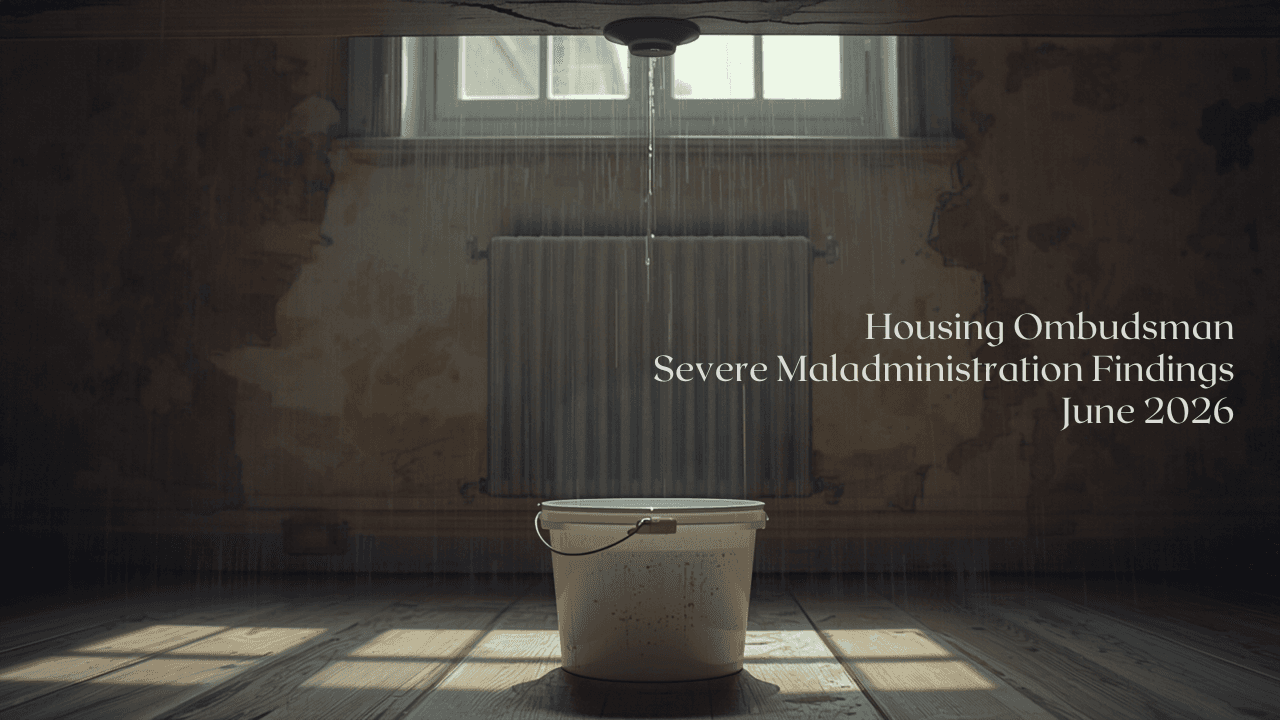
What the Housing Ombudsman's 2026 Maladministration Report Means for Tenants
5 min read
The June 2026 Ombudsman report found severe maladministration over roof leaks left unresolved for years, and what that means if a repair is ignored.
Read guide
Housing Ombudsman Annual Review 2025-26: What the Figures Mean for Tenants
5 min read
The Ombudsman investigated more complaints in 2025-26 and upheld 72% of repairs cases. What the annual review means for tenants.
Read guideNeed Help?
Council Repair Claims can help you understand whether your situation may support a disrepair claim and, if appropriate, refer you to a regulated solicitor. There is no charge for our assessment, and no obligation to continue. If you choose to go ahead, the solicitor will explain their own terms and any charges before you agree. You are not required to use our service. You can also complain directly to your landlord or contact the Housing Ombudsman for free.
Council Repair Claims is a trading style of Ashworth & Ingram Compensation Partners Ltd, authorised and regulated by the FCA for claims management activity, FRN 1042169. We are a claims management company, not a law firm, and can't give legal advice. You don't need to use a claims management company. You can complain to your landlord and, if unresolved, refer it to the Housing Ombudsman Service yourself for free.
Prefer the Ombudsman's own site? housing-ombudsman.org.uk
Contact us on 03330 111104 or email info@councilrepairclaims.co.uk
This article is for general information only and does not constitute legal advice. Details of the Housing Ombudsman's service are drawn from its published guidance.
Content correct as of Nov 2026.