
The June 2026 Ombudsman report found severe maladministration over roof leaks left unresolved for years, and what that means if a repair is ignored. This free guide for council and housing association tenants in England and Wales is published by Council Repair Claims, a regulated claims management company, not a law firm.
What the Housing Ombudsman's 2026 Maladministration Report Means for Tenants
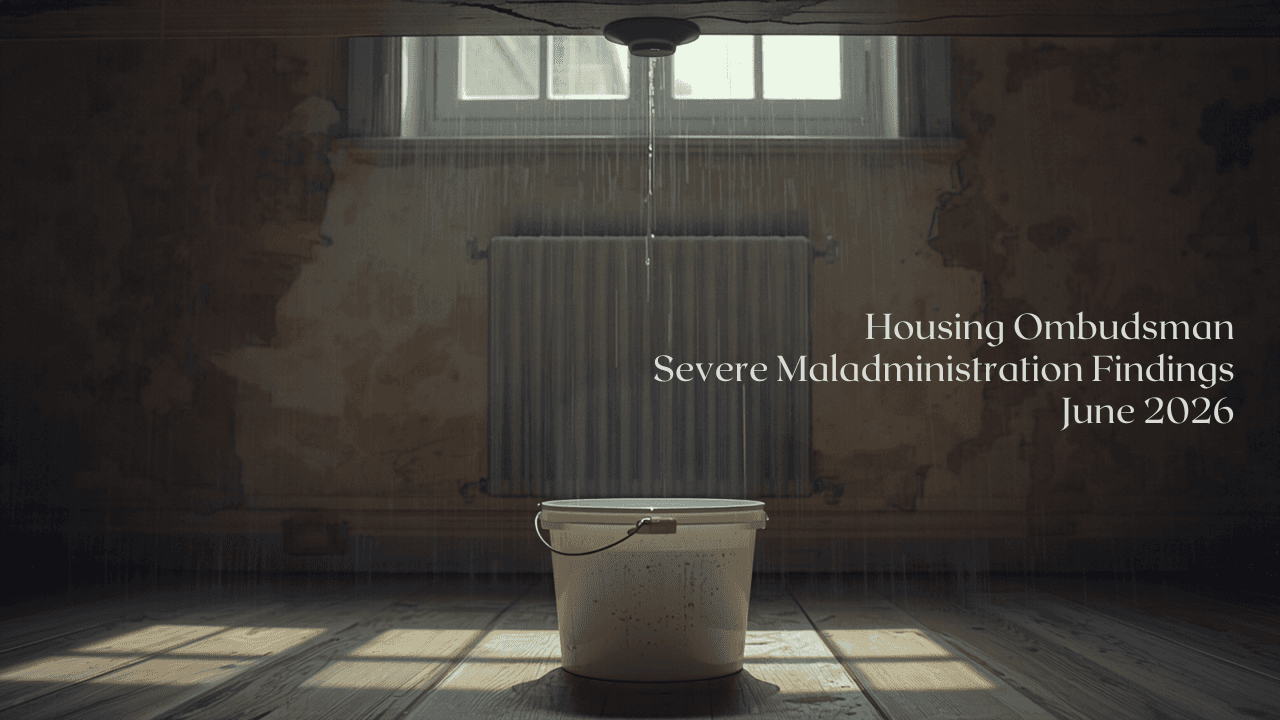
The Housing Ombudsman has published its latest findings on severe maladministration. The cases involve councils and housing associations that left roof leaks unresolved for years and the human cost of those failures.
Every year the Housing Ombudsman publishes reports on the most serious cases it has investigated. A finding of severe maladministration is the strongest possible verdict. It means a landlord failed significantly in its duties and caused real harm, distress, or disadvantage to the people living in the property.
The June 2026 report focuses on roof leaks and what happens when councils and housing associations leave them unresolved. The cases document a recurring pattern of failure, what it costs tenants in their daily lives, and what it means now that Awaab's Law is in force.
Key Points
- The Housing Ombudsman's June 2026 report found severe maladministration against multiple named councils and housing associations over unresolved roof leaks, in some cases lasting more than three years
- The common failures across these cases were: no proper risk assessment, no consideration of a temporary move, temporary patches applied without fixing the underlying cause, and poor communication throughout
- Vulnerability matters. In several cases children, people undergoing cancer treatment, and those recovering from serious illness were living in affected rooms. Landlords repeatedly failed to take household vulnerability into account when deciding how urgently to act
- Since October 2025, Awaab's Law requires social landlords in England to investigate emergency hazards within 24 hours. These cases pre-date the law but they show exactly the kind of failure it was designed to prevent
- The Ombudsman ordered £11,000 in compensation in one case. These are not hypothetical outcomes. They are what actually happened when tenants escalated through the formal process. They do not represent an average payout
- If your landlord is failing to fix a roof leak or is carrying out repeated temporary repairs that keep failing, you have the right to complain formally and escalate to the Housing Ombudsman
If your landlord has ignored a repair you reported, it is worth finding out where you stand.
Our free eligibility check takes two minutes and carries no obligation to proceed.
What These Cases Show
The report covers 13 findings of severe maladministration across nine landlords, including London Borough of Lambeth, London Borough of Haringey, Stonewater, L&Q, Sanctuary, Riverside, Southern Housing, East Devon Council, and London Borough of Wandsworth.
The delays in these cases were not minor. One landlord took 27 months to fix a roof. Another knew about a leak for over 11 months without carrying out effective repairs. Several cases ran for three years or more. In one case involving Sanctuary, the leak in a resident's bedroom remained unresolved for over three years while she was undergoing chemotherapy. In another involving Stonewater, water dripping through an unresolved leak reached a child's television and caused a small fire.
The report is addressed at landlords, but the patterns it documents are useful for any tenant dealing with an unresolved repair. Recognising what severe maladministration looks like in practice can help you respond to it at the right moment.
A severe maladministration finding looks at one complaint. A further investigation, sometimes still called a Paragraph 49 investigation, asks whether the same failures run across the whole organisation. That is explained in What Is a Paragraph 49 Investigation? A Tenant's Guide.
The Five Failures That Keep Appearing
Across every case in this report, the same problems appear in different combinations.
No risk assessment. When a landlord is aware of a serious problem in a home where children, elderly people, or someone with a serious health condition is living, it should be assessing the risk to that household and deciding what extra steps are needed. In case after case, the Ombudsman found no evidence that any risk assessment had taken place, even where the landlord had recorded the severity of the problem as high.
No consideration of a temporary move. If a room or a home becomes unusable because of ongoing disrepair, the landlord should consider whether the tenant needs to be moved temporarily while repairs are carried out. Several families in this report had to live in damaged, cold, or mouldy rooms for months or years without their landlord ever raising the option of a temporary move.
Temporary repairs that do not fix the cause. Multiple landlords sent contractors who carried out surface-level work without investigating or addressing the underlying fault. The same problems returned. The Ombudsman found that repeated contractor attendance is not the same as a completed repair. A landlord that keeps treating the symptom while leaving the cause unresolved is still failing in its duty.
Poor communication. In almost every case, residents had to chase their landlord repeatedly for updates. Landlords did not explain delays, did not provide timescales, and did not communicate when appointments were cancelled or works were not going to happen.
Inadequate records. Several landlords could not show what work had been carried out, when inspections had taken place, or what contractors had found. In one case it was unclear when a leak had started because no records existed from previous inspections. Good records protect tenants as well as landlords. They show what was reported, when, and what happened in response.
What Awaab's Law Changes
The Ombudsman's introduction to this report makes an important point: every case in the report pre-dates Awaab's Law. None of these landlords were subject to the fixed legal deadlines that now apply to social landlords in England.
Since October 2025, a roof leak that creates an emergency hazard must be investigated and safety work completed within 24 hours of the landlord becoming aware. Significant hazards must be investigated within 10 working days. If a landlord cannot complete repairs in time, they must consider temporary measures and, where necessary, arrange temporary accommodation.
The cases in this report represent what landlords could get away with before the law changed. They should not be happening now.
If your landlord is applying repeated temporary fixes without explaining delays or considering the vulnerability of your household, the legal framework has changed. The 24-hour and 10-working-day deadlines are not targets. They are legal obligations, and missing them is itself evidence of a breach of duty.
What to Do If This Sounds Familiar
If your landlord has been applying temporary patches to a leak without fixing the underlying cause, or has been delaying without explanation, there are clear steps to follow.
Report the problem in writing if you have not already done so, stating the date, what the problem is, and how it is affecting your household, particularly if anyone in the home is a child, elderly, or has a serious health condition. Ask your landlord to carry out a proper investigation of the cause, not just the visible symptom.
If the response is inadequate, use your landlord's formal complaints process. Keep every piece of correspondence, every appointment record, and photographs of the affected area taken regularly over time. When the complaints process is exhausted, the Housing Ombudsman is free to use and independent. As this report shows, it does order compensation and compel landlords to act.
If your landlord has ignored a repair you reported, it is worth finding out where you stand.
Our free eligibility check takes two minutes and carries no obligation to proceed.
Frequently Asked Questions
Related guides
What Is a Paragraph 49 Investigation? A Tenant's Guide
5 min read
How the Housing Ombudsman investigates councils and housing associations for wider failures, not just a single complaint.
Read guide
Housing Ombudsman explained
4 min read
The Housing Ombudsman is a free, independent service for council and housing association tenants if your landlord will not fix your home.
Read guide
Awaab's Law
6 min read
From October 2025, social landlords in England must investigate damp, mould, and emergencies within strict legal deadlines under Awaab's Law.
Read guideNeed Help?
Council Repair Claims can help you understand whether your landlord's failure to act may support a disrepair claim and connect you with a regulated solicitor on a no-win, no-fee basis, provided you co-operate fully with your solicitor and act honestly throughout. You are not required to use our service. You can also complain directly to your landlord or contact the Housing Ombudsman for free.
Contact us on 03330 111104 or email info@councilrepairclaims.co.uk
This article summarises the Housing Ombudsman's Learning from Severe Maladministration report, published June 2026. All cases and findings cited are drawn from that public document. This article is for general information only and does not constitute legal advice.
Content correct as of Oct 2026.