
How council and housing association tenants report repairs, track deadlines, and escalate when the landlord keeps delaying. This free guide for council and housing association tenants in England and Wales is published by Council Repair Claims, a regulated claims management company, not a law firm.
Council Property Repairs: How to Get Them Fixed and What to Do If They Are Not
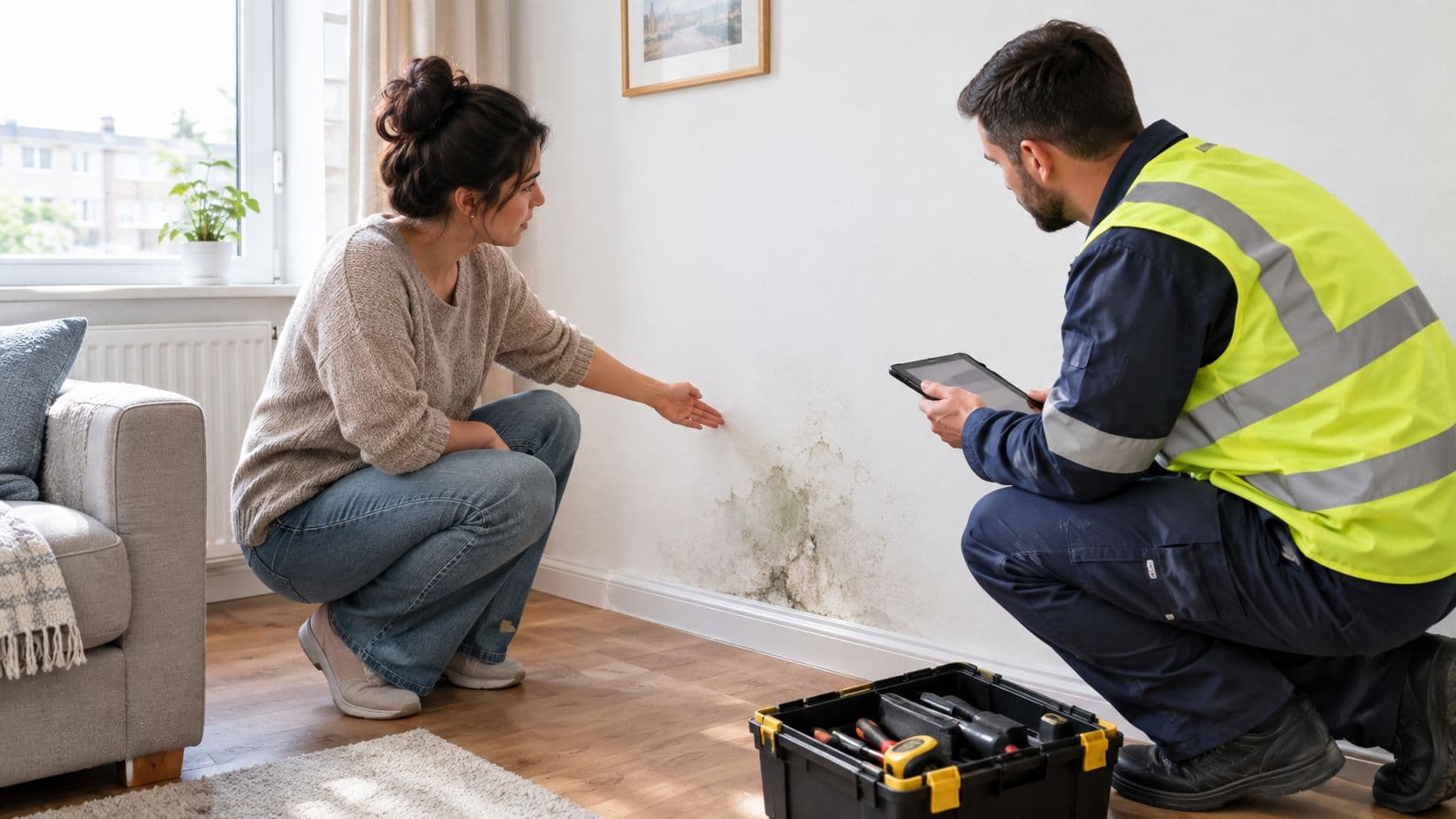
Getting a repair logged is the easy part. Getting it properly fixed, and keeping the evidence that shows it was not, is what actually matters.
A leaking ceiling, mould around a bedroom window, or a broken boiler can turn an ordinary home into a daily source of worry. Tenants often report the same fault more than once, receive a temporary patch, then wait while the underlying problem returns. The practical issue is not just whether your landlord has a repair duty. It is whether you can show what was reported, when it was reported, what your landlord did, and why the problem remains unresolved.
Key Points
- Your landlord must know about a repair problem before they have any legal obligation to act. Report it promptly and, wherever possible, in writing so the date is clear and provable
- A temporary improvement is not the same as a completed repair. If the same problem keeps returning, the underlying cause has not been fixed and your landlord needs to investigate it properly
- Since October 2025, Awaab's Law requires council and housing association landlords in England to investigate emergency hazards within 24 hours and significant damp and mould within 10 working days of being notified
- Keep evidence that matches the repair timeline: not just a photograph of the problem, but records of when you reported it, what your landlord said, what was done, and what was left unresolved
- If your landlord does not respond adequately, you have escalation routes: their formal complaints process, the Housing Ombudsman in England, and legal action through a housing disrepair solicitor
- In 2024-25, 73% of Housing Ombudsman repairs complaints were upheld. A clear, organised evidence file makes the difference between a complaint that goes somewhere and one that does not
If your landlord has ignored a repair you reported, it is worth finding out where you stand.
Our free eligibility check takes two minutes and carries no obligation to proceed.
Reporting the Repair to Your Council or Housing Association
Your landlord must know about the problem before they have any legal obligation to act. A phone call can help for an urgent hazard, but always follow it with a written message (email, text, or letter) identifying the property, describing the defect, and asking for a written repair reference and an appointment date.
Written reporting is strongly recommended because it proves the date and content of your notification. Verbal notice can be sufficient if it can be proved later, but it is much harder to rely on in a dispute.
When reporting a repair, keep the description factual rather than argumentative. "Water is entering around the bedroom window after rain" is stronger than guessing at the cause. Ask your landlord to investigate the underlying cause, not just clean or paint over what is visible. If you are reporting mould, mention any associated faults (a history of recurrence, failed ventilation, or damp patches nearby) because they give context that helps establish the structural cause.
Understanding Repair Deadlines: What Awaab's Law Requires
Since October 2025, Awaab's Law has changed the practical question from "how long has the tenant been waiting?" to "what hazard was reported, when did the landlord know, and which deadline applies?"
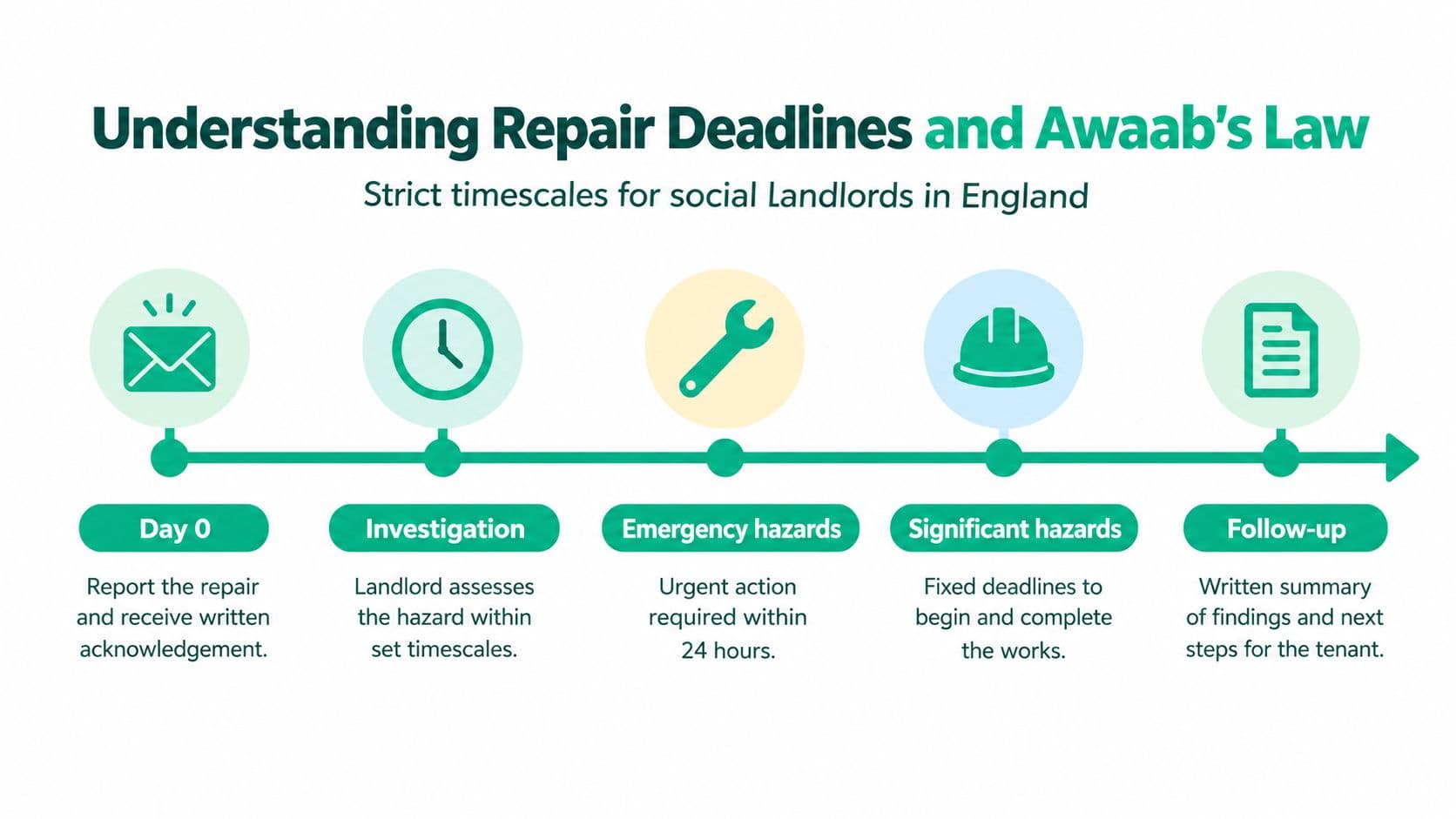
In England, council and housing association landlords must investigate potential emergency hazards and complete relevant safety work within 24 hours of becoming aware of the hazard. Significant hazards must be investigated within 10 working days, with a written summary provided within 3 working days of the investigation. Preventive works must begin within 5 working days, or where that is not possible, within 12 weeks.
The clock starts from the point your landlord becomes aware of the hazard, which is why your first written report and its date matter so much.
Awaab's Law applies in England only. If you live in Wales, different rules apply and a separate guide covers what is relevant to you: Housing disrepair in Wales: your rights and how the system works.
The Evidence to Keep at Each Stage
A repair file should show more than a photograph of a stain. The most useful evidence matches the repair timeline. It shows when the landlord was told, what they did, and what remains unresolved.
| Stage | Evidence to retain |
|---|---|
| Notice of the hazard | Original report, repair reference, call record, or portal screenshot |
| Investigation | Appointment confirmation, inspection report, photographs of condition at that date |
| Safety action | Details of work started, any temporary measures put in place, remaining risks noted |
| Written summary | Your landlord's findings, planned works, and next steps in writing |
| Completion | Contractor record, completion date, photographs after the work, any follow-up inspection |
The key detail courts and the Housing Ombudsman both look for is not just that a problem existed, but that it was reported, that the landlord knew, and that the response was inadequate or late.
Keep a dated log of every report, inspection, missed appointment, and contractor visit. Save every written exchange. Note any impact on your household (rooms that cannot be used properly, damaged belongings, health effects, or disrupted sleep). When you send evidence to the Housing Ombudsman, a one-page chronology setting out the timeline in sequence often works better than a large, unordered folder of documents.
What to Do If the Repair Is Not Properly Fixed
A repair that treats the visible symptom but not the underlying cause is not a completed repair. If mould returns after your landlord has painted or treated the surface, or if a leak recurs after a patch, photograph the recurrence immediately, note the date, and report it again in writing referencing the previous repair reference.
When chasing an unresolved repair, ask your landlord six specific questions and keep a record of what they say:
- When did you first record this problem?
- What hazard or defect was identified?
- What work was authorised and what is still outstanding?
- Why were any relevant deadlines or service standards missed?
- When will the permanent work be finished?
- How will you confirm the defect is fully resolved?
Their answers, or their failure to provide them, become part of your evidence file.
The Housing Ombudsman's severe maladministration findings show how often this pattern repeats. In one documented case, damp and mould remained permanently unresolved 49 months after it was first reported. Repeated contractor visits, in that case as in many others, did not amount to a completed repair.
Escalating When the Landlord Does Not Act
If reporting and chasing is not working, there are clear escalation routes available.
Your landlord's formal complaints process is usually the required first step. Use it formally, in writing, referencing your original report date and repair reference. Keep all responses. A complaint may produce faster action or a clear refusal that allows you to escalate further.
The Housing Ombudsman Service is free and independent. It investigates how your landlord handled the situation and can order repairs, an apology, and compensation. It covers England only. You generally need to have completed your landlord's complaints process first. In Wales, use your landlord's complaints process and then the Public Services Ombudsman for Wales.
Legal action through a housing disrepair solicitor becomes appropriate when the disrepair is serious, has affected your health, or has continued despite formal complaints. A solicitor can write formally to your landlord requiring repairs and, where the evidence supports it, compensation. Most housing disrepair solicitors work on a no-win, no-fee basis, provided you co-operate fully with your solicitor and act honestly throughout.
If your landlord has ignored a repair you reported, it is worth finding out where you stand.
Our free eligibility check takes two minutes and carries no obligation to proceed.
Frequently Asked Questions
Related guides

Landlord responsibilities
6 min read
What your council or housing association landlord must legally repair, how quickly they must act, and what to do if they ignore your reports.
Read guide
What evidence do you need for a housing disrepair claim?
6 min read
Photos, written reports, medical records and losses: evidence that strengthens a housing disrepair claim, even if you have not kept records.
Read guide
Housing Ombudsman explained
4 min read
The Housing Ombudsman is a free, independent service for council and housing association tenants if your landlord will not fix your home.
Read guideNeed Help?
Council Repair Claims can help you understand whether your situation may support a disrepair claim and connect you with a regulated solicitor on a no-win, no-fee basis, provided you co-operate fully with your solicitor and act honestly throughout. You are not required to use our service. You can also complain directly to your landlord or contact the Housing Ombudsman for free. In Wales, the equivalent route is the Public Services Ombudsman for Wales.
Contact us on 03330 111104 or email info@councilrepairclaims.co.uk
This article is for general information only and does not constitute legal advice. The outcome of any complaint, Ombudsman referral, or legal claim depends on the specific facts and evidence in each case.
Content correct as of Sep 2026.