
Damp and mould in social housing is usually a structural problem, not a cleaning problem. Here is how to deal with it safely. This free guide for council and housing association tenants in England and Wales is published by Council Repair Claims, a regulated claims management company, not a law firm.
How to Get Rid of Damp and Mould in Social Housing, and Why It Keeps Coming Back
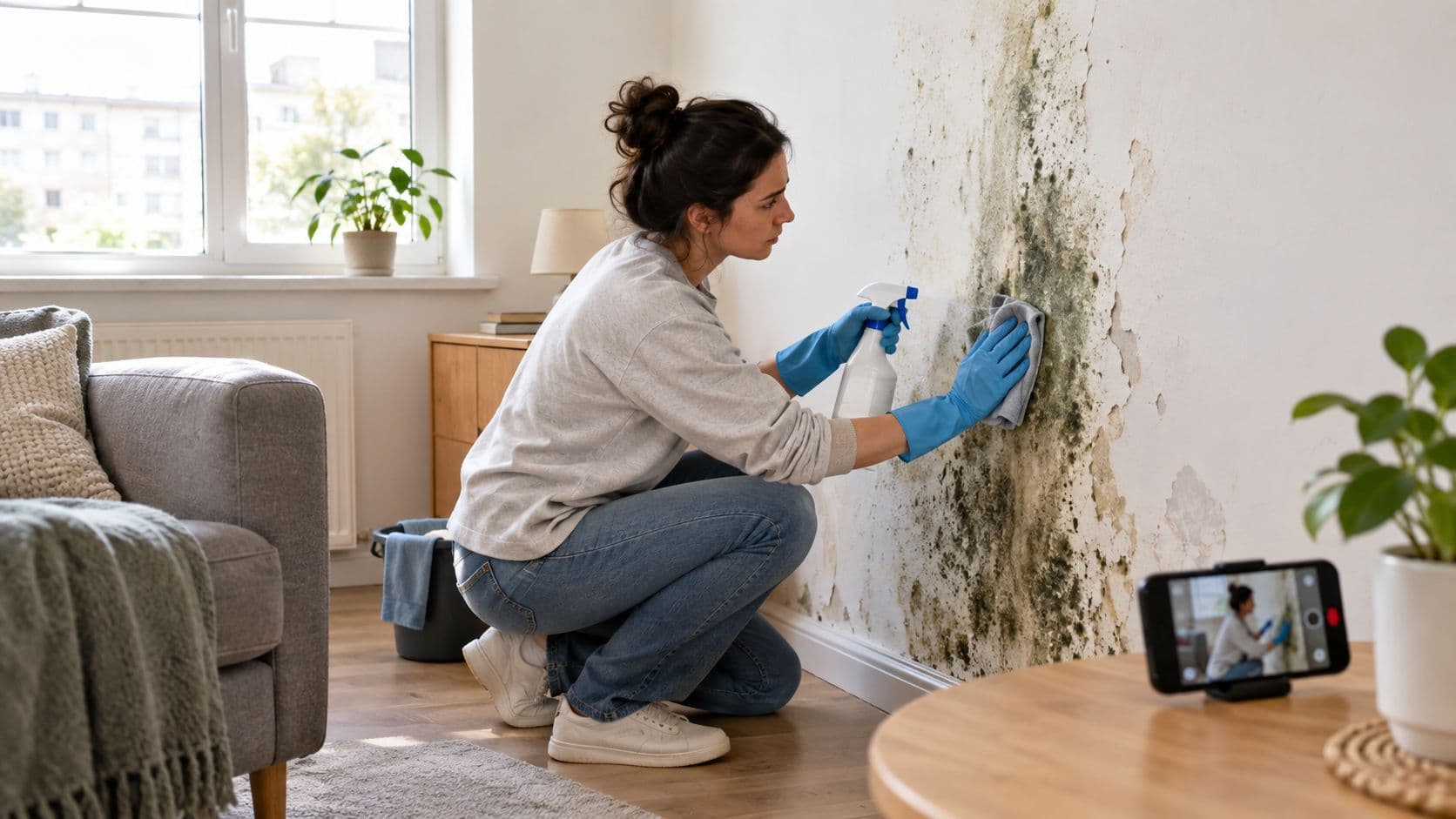
Cleaning the wall buys you time. Getting the landlord to fix the cause is the actual job.
You notice a dark patch behind a wardrobe and that damp, stale smell that does not go away. The instinct is to wipe the wall and open a window. That is a reasonable first step, but in social housing, visible mould is usually a symptom of something deeper. A structural fault, a failed seal, a leak, or inadequate ventilation built into the building is what keeps bringing the mould back. If the underlying cause is your landlord's responsibility and they have been told about it, you may have more options than cleaning products.
Key Points
- Visible mould is usually a symptom of a moisture problem underneath (a structural fault, a leak, or inadequate ventilation). Cleaning the surface treats the symptom, not the cause
- Small areas of surface mould can be cleaned safely, but if the mould keeps returning after cleaning, the underlying cause has not been fixed
- Your landlord must be told about the problem before they have any legal obligation to act. Report it promptly and, wherever possible, in writing
- Since October 2025, Awaab's Law requires council and housing association landlords in England to investigate significant damp and mould within 10 working days of being notified
- If your landlord has been told about a recurring damp or mould problem and has failed to address the underlying cause, you may be entitled to repairs and, where the evidence supports it, compensation
- England and Wales are not the same. England has statutory deadlines for social housing damp and mould cases. Wales relies on the complaints process and the Public Services Ombudsman for Wales
If your landlord has ignored a damp or mould problem you reported, it is worth finding out where you stand.
Our free eligibility check takes two minutes and carries no obligation to proceed.
Why Mould Keeps Coming Back
A lot of people assume mould in their home is mainly a cleaning problem. In social housing, it rarely is. The most current government data shows 7.7 million households (31% of all homes in England) reported a condensation, damp, or mould issue, while official health-risk guidance estimates the underlying prevalence of structural damp and mould at between 4% and 27% of homes.1 That gap between reported problems and confirmed defects explains why landlords so often suggest the problem is lifestyle rather than structure.
The practical rule is simple: if mould comes back after cleaning, the job is not finished. The moisture source still needs to be found and fixed. In social housing that source is frequently structural: a failing damp proof course, penetrating damp through cracked render, a roof or window seal fault, or ventilation that is inadequate for the building design. None of these are things a tenant can or should fix themselves. They are the landlord's legal responsibility.
1. English Housing Survey 2024 to 2025, perceptions and impacts of housing quality.
Cleaning Mould Safely: What to Do Right Now
Small areas of surface mould can be dealt with at home while you wait for the underlying problem to be addressed. Treat it as a health risk, not a quick wipe-down.
- Use a specialist mould removal product rather than ordinary household cleaners, or a solution of white vinegar and water
- Wear rubber or disposable gloves throughout and keep the room ventilated. Open windows before you start
- Apply the product directly to the affected area and follow the label instructions
- Do not dry-brush the mould. This releases spores into the air. Wipe instead
- Wash your hands and clothing afterwards
This deals with the visible growth, but it does not fix the source. Keep a note of when the mould appeared, which room it was in, and when it returned after cleaning. That record matters later.
Reducing Moisture: Small Steps That Help
While you wait for the underlying repair, reducing moisture in the home can slow the mould's return. None of these steps can substitute for a structural repair, but they reduce the daily moisture load that feeds growth.
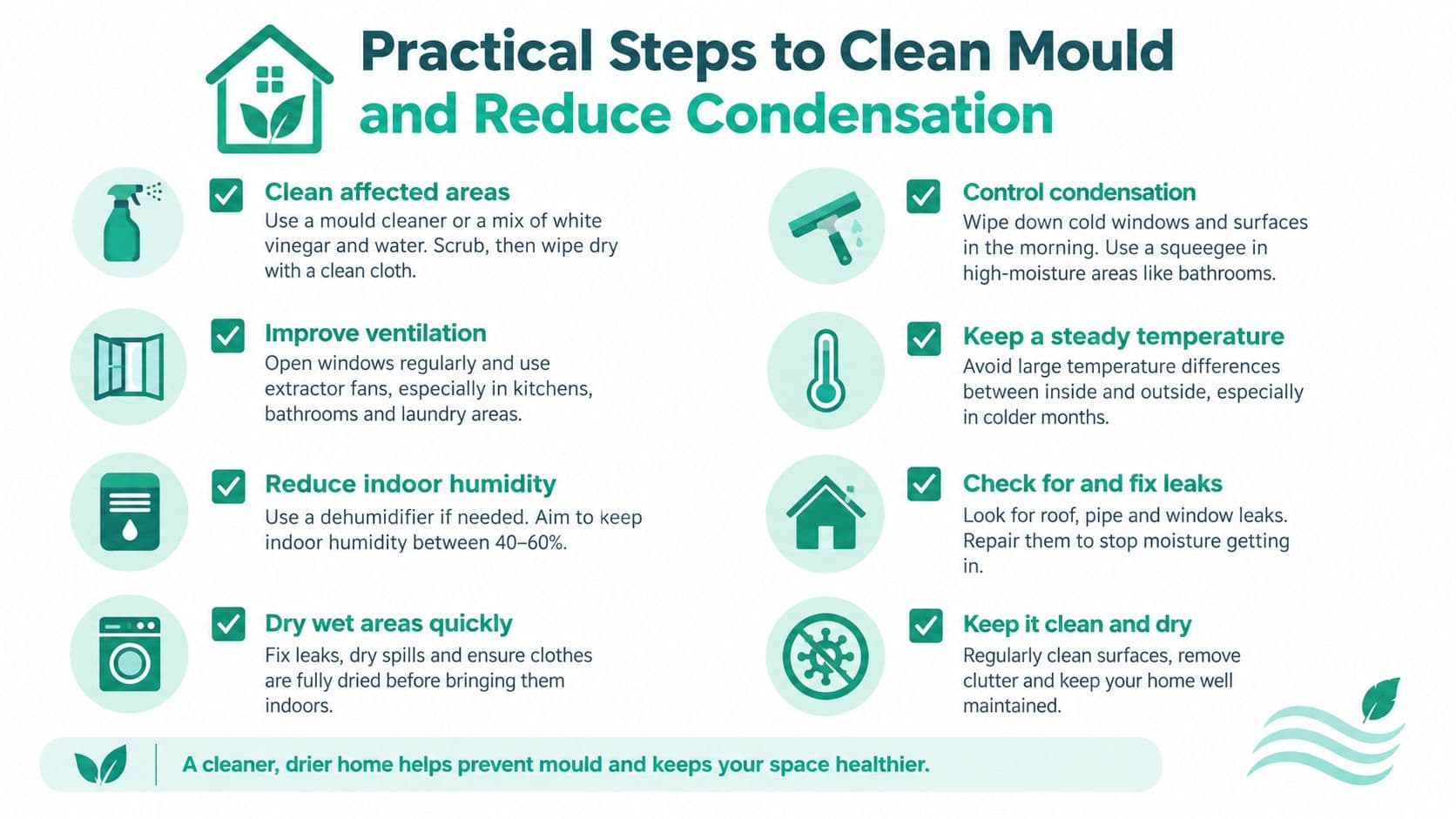
The most effective steps are improving ventilation, keeping a low background temperature rather than letting the home get cold, drying clothes outside or in a well-ventilated room rather than on radiators, and keeping furniture a few centimetres away from external walls so air can circulate behind them.
If you notice condensation forming on windows each morning, wipe it away promptly. Cold surfaces and trapped warm air are the conditions mould needs.
Reporting the Problem to Your Landlord
Your landlord must be told about the problem before they have any legal obligation to act. Report damp and mould as soon as you see it and, wherever possible, in writing (by email, letter, or text message).
When you report it, be specific. Say which room is affected, whether the mould is new or returning after a previous repair, whether it is spreading, and whether you can see any building defect that might be causing it (a crack in the wall, a failed seal around a window, or a leak from above). If anyone in the household is feeling unwell, speak to your GP and ask for it to be noted in your records.
Since October 2025, Awaab's Law requires council and housing association landlords in England to investigate significant damp and mould within 10 working days of being notified. For emergency hazards, the deadline is 24 hours. If your landlord misses these deadlines after being notified, that failure is itself evidence of a breach of their legal duty.
If you are in Wales, the same statutory deadlines do not apply, but you have the same right to report the problem and escalate through the formal complaints process and the Public Services Ombudsman for Wales if your landlord does not respond adequately.
What to Do If the Mould Keeps Returning
If you have cleaned the mould and it keeps coming back, and your landlord has been told about it without fixing the underlying cause, this is no longer just a cleaning problem. It is a housing disrepair problem, and one your landlord is legally required to address.
At that point the right steps are to document the pattern clearly, keep every written report and every landlord response, photograph the recurrence with dates, and note any health impact in writing.
If your landlord has ignored a damp or mould problem you reported, it is worth finding out where you stand.
Our free eligibility check takes two minutes and carries no obligation to proceed.
Frequently Asked Questions
Related guides

What evidence do you need for a housing disrepair claim?
6 min read
Photos, written reports, medical records and losses: evidence that strengthens a housing disrepair claim, even if you have not kept records.
Read guide
Awaab's Law
6 min read
From October 2025, social landlords in England must investigate damp, mould, and emergencies within strict legal deadlines under Awaab's Law.
Read guide
Housing disrepair in Wales
7 min read
Welsh tenant rights for housing disrepair: Renting Homes Act, PSOW complaints route, and how Wales differs from England.
Read guideNeed Help?
Council Repair Claims can help you understand whether recurring damp or mould in your home may support a disrepair claim and connect you with a regulated solicitor on a no-win, no-fee basis, provided you co-operate fully with your solicitor and act honestly throughout. You are not required to use our service. You can also complain directly to your landlord or contact the Housing Ombudsman for free. In Wales, the equivalent route is the Public Services Ombudsman for Wales.
Contact us on 03330 111104 or email info@councilrepairclaims.co.uk
This article is for general information only and does not constitute legal advice.
Content correct as of Sep 2026.