
What HHSRS means for council and housing association tenants: how hazards are scored, Category 1 and 2, and what to do if repairs stall. This free guide for council and housing association tenants in England and Wales is published by Council Repair Claims, a regulated claims management company, not a law firm.
HHSRS Meaning for Tenants: A Plain English Guide
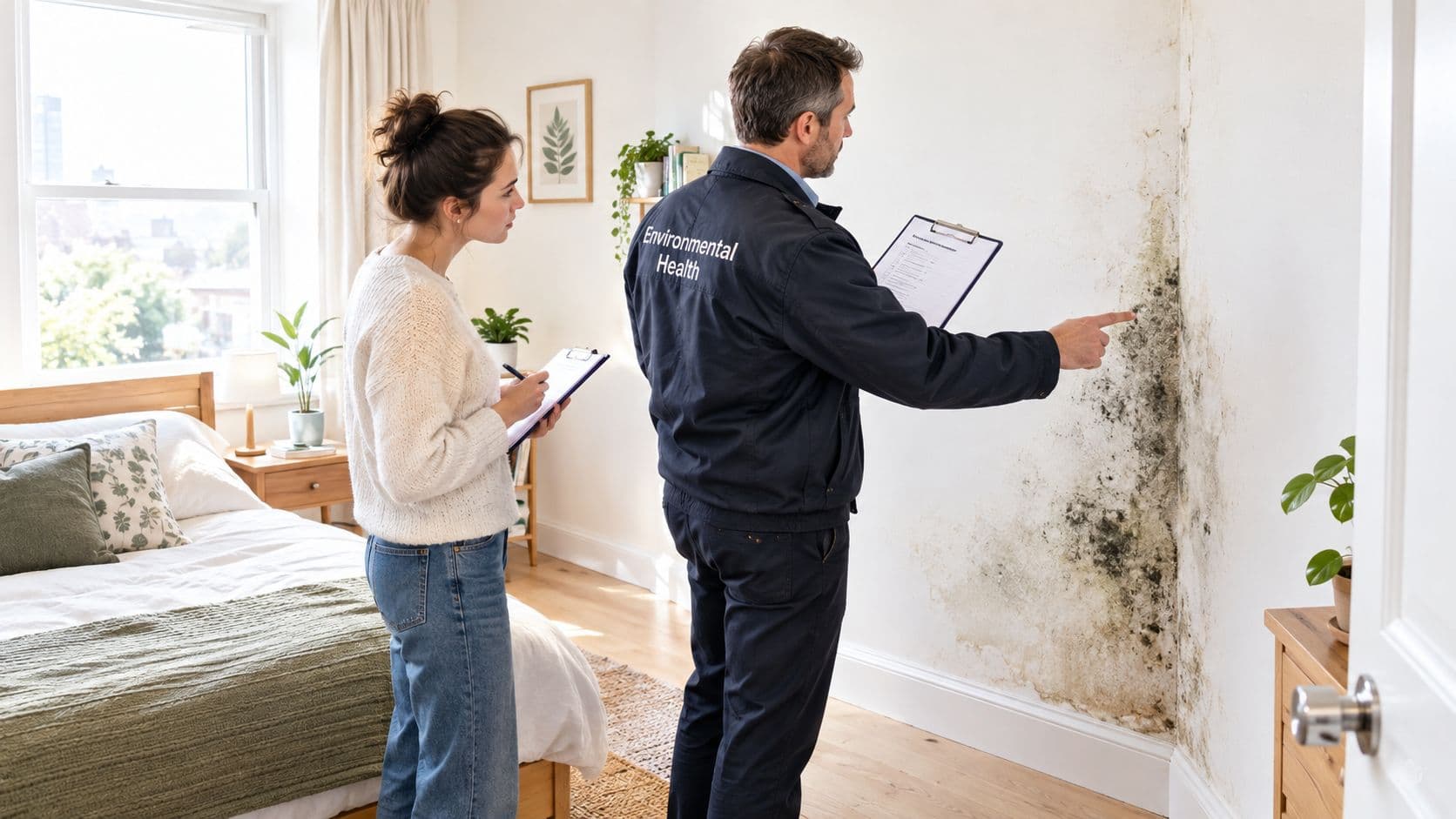
You have heard HHSRS during a repair complaint and are not sure what it means for your home. Here is how councils score hazards, and what to do next.
HHSRS means the Housing Health and Safety Rating System, the official risk-based system used in England and Wales to assess housing hazards in homes. It has been in force since April 2006 and is used to look at 21 potential hazards, so when tenants ask about HHSRS meaning, they are really asking how councils decide whether conditions like damp, mould, broken heating, leaks, or unsafe electrics make a home unsafe.
A lot of tenants first hear the term only after months of chasing repairs. There might be black mould in a child's bedroom, water coming through a ceiling, or a boiler that keeps failing in winter. The landlord may say the problem is minor, or blame condensation, or keep promising to inspect without putting things right.
That is where HHSRS matters. It gives environmental health officers and councils a structured way to assess risk in a home, rather than just asking whether something looks defective. For tenants in council or housing association homes in England and Wales, it often becomes the bridge between a repair complaint and formal action.
Key Points
- HHSRS means Housing Health and Safety Rating System, the official hazard assessment used in England and Wales to judge risks in homes, not just whether something looks broken
- It was introduced by the Housing Act 2004 and has been in force since April 2006, replacing the older Housing Fitness Standard
- It is not a pass or fail test. Inspectors score how likely a hazard is to cause harm and how serious that harm could be
- Category 1 is the serious band. In England, local authorities must take enforcement action. Category 2 is a lower band, but it is still a recognised hazard
- Everyday problems such as damp, mould, leaks, cold homes, unsafe electrics, and unsafe stairs can all be scored as hazards
- A disrepair claim usually depends on the landlord having been notified. Written reports are strongly recommended because they create a clear record
If your landlord has ignored a repair you reported, it is worth finding out where you stand.
Our free eligibility check takes two minutes and carries no obligation to proceed.
What HHSRS Actually Means for Your Home
A family in a council house notices black mould spreading across a bedroom wall. Their toddler has a cough that will not settle. The landlord says the room needs more ventilation and treats it like a housekeeping issue rather than a repair problem.
That kind of situation is exactly where HHSRS meaning becomes practical, not just technical. It stands for Housing Health and Safety Rating System, the system used in England and Wales to assess hazards in residential property. It helps councils and environmental health officers decide whether a problem in a home creates a real risk to health or safety.
It looks at risk, not just defects
A wall with mould on it is not judged only as a stain on plaster. An inspector looks at what that mould could do to the people living there. If a child, older person, or someone with asthma is likely to be affected, that matters.
That is why tenants often get confused when a landlord says there is a problem, but it is not serious. Under HHSRS, the key question is not whether something exists. The question is whether it creates a hazard.
Practical rule: A home can look ordinary and still contain a serious hazard if the condition creates a real risk of illness, injury, or harm.
Why tenants hear about HHSRS during complaints
When a repair report reaches the local authority, HHSRS is often the tool used to assess the home. It gives officers a formal framework for deciding how serious the problem is and whether the council should step in. For a tenant, that can affect:
- Priority: if the issue needs urgent attention
- Evidence: if the condition of the home has caused harm
- Enforcement: if the landlord has not dealt with the problem after being told about it
The term can sound distant, but the everyday meaning is simple. It is the system used to judge whether housing conditions are unsafe.
Where HHSRS Comes From and Why It Exists
A tenant reports black mould in a bedroom. The landlord replies that the home is still habitable, so the problem can wait. HHSRS was brought in to deal with exactly that kind of gap between a home being liveable on paper and a home being safe in real life.
The Housing Health and Safety Rating System was created under the Housing Act 2004 and began replacing the old Housing Fitness Standard in 2006. In Wales, the Welsh Government explains that HHSRS replaced the Fitness Standard in July 2006, as set out in the Welsh housing hazards quality report.
The old test asked a narrower question
The earlier standard mainly looked at whether a property was fit to live in at a basic level. A home could pass that older test and still expose the people living there to damp, cold, falls, fire risk, or unsafe electrics.
HHSRS changed the focus from the building on its own to the effect of the building on the people inside it. In plain English, it asks: what in this home could cause harm, who is likely to be affected, and how serious could that harm be?
Why the system exists
HHSRS exists to help councils judge risk in a more practical way. It gives environmental health officers a shared method for deciding when housing conditions have crossed the line from poor repair into a health or safety hazard. If a hazard is serious, that can support:
- A stronger complaint record
- A council inspection
- Formal enforcement against the landlord
- Useful evidence in a housing disrepair claim
HHSRS is not only background law or council paperwork. It often becomes the framework that links a problem such as damp, cold, or broken stairs to the next practical steps: photos, medical evidence, inspection findings, notices to the landlord, and, if needed, legal action. The official method is set out in the government's HHSRS operating guidance.
How Inspectors Score Hazards Under HHSRS
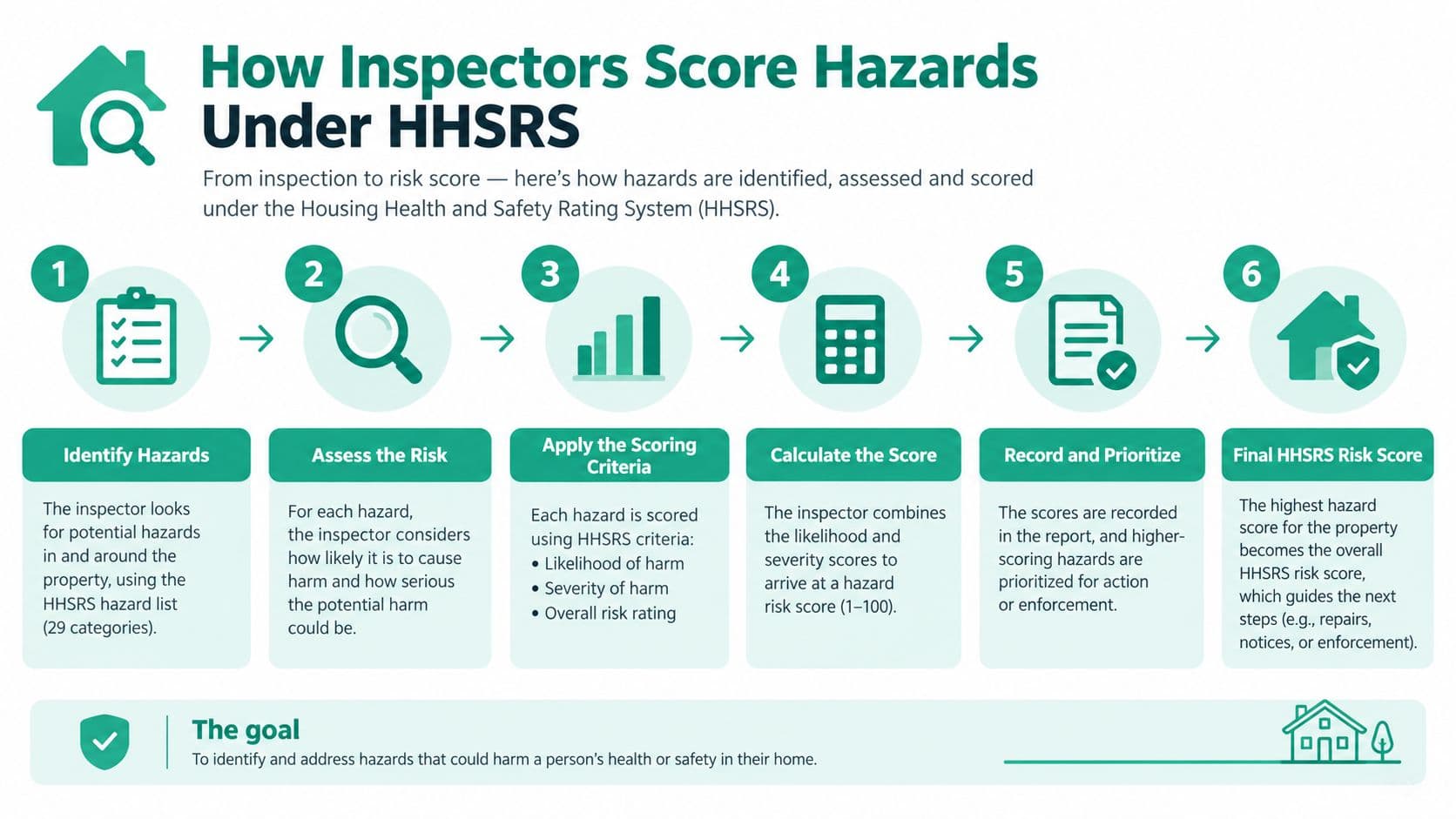
A tenant reports black mould in a bedroom, a loose stair rail, and a heater that barely works. An inspector does not count three problems and move on. Under HHSRS, the inspector asks a more practical question: how likely is each problem to harm someone in the home, and how serious could that harm be?
That is why HHSRS works more like a risk meter than a repair checklist. The condition itself matters, but the focus is the effect that condition could have on the people living there.
What inspectors are actually measuring
- Likelihood of harm: the chance that the hazard will cause harm over time.
- Severity of harm: how bad the harm could be if it happens, from a relatively minor injury or illness to a very serious one.
Those two parts are combined into a score. A hazard with a higher chance of causing serious harm will score more highly than a hazard that is less likely to cause only limited harm.
What kinds of problems can be scored
- Damp and mould
- Excess cold or excess heat
- Hazardous materials such as asbestos or lead
- Poor lighting, noise, overcrowding, or security problems
- Water supply and hygiene issues
- Falls on stairs or floors
- Fire, electricity, and risk of collapse
A home does not need to be falling apart before HHSRS becomes relevant. A repeated leak, poor ventilation, or unsafe stairs can still score as hazards if they create a real risk of illness or injury.
How this works in real life
Take damp and mould. An inspector will usually look beyond the stain on the wall itself. They will consider where the mould is, how widespread it is, whether it keeps returning, whether the room can be heated and ventilated properly, and who is likely to be affected.
A child sleeping in a mouldy, cold bedroom may face a higher level of risk than a healthy adult briefly using a box room with a small patch of condensation. The visible defect may look similar at first glance. The likely harm is not. The same approach applies to stairs, exposed wiring, broken windows, or heating failures.
Why the score matters to a tenant
This is not a pass or fail exercise. It is a way of ranking danger so the council can decide how serious the hazard is. Two tenants might both complain about mould, but the stronger case is usually the one that shows the mould is persistent, affects daily living, and is linked to health symptoms, medical advice, or failed repair reports.
If you understand how officers score hazards, your reporting becomes more useful. Instead of saying there is mould in the bedroom, you can describe the size of the affected area, how long it has lasted, whether the wall feels wet, whether windows or vents do not work, who sleeps there, and what symptoms have followed.
Category 1 and Category 2 Hazards Explained
A tenant might hear that an inspection found a Category 2 hazard and assume the problem is minor. That can be misleading. The label does not mean the damp, cold, faulty electrics, or unsafe stairs are acceptable. It means the inspector judged the level of risk to be lower than the top band.
Category 1 and Category 2 are the two main hazard bands used after a risk is scored under HHSRS. In plain English, they tell the council how serious the danger is and how strongly it may need to step in.
| Hazard band | What it means for the tenant | What it usually means for council action |
|---|---|---|
| Category 1 | The condition creates a serious risk to health or safety | The local authority has a duty to take enforcement action in England |
| Category 2 | The condition still creates a recognised risk, but at a lower level | The local authority can still act, but it has more choice about whether and how to do so |
Category 1 points to a hazard serious enough that formal action is expected. Category 2 still matters, because it records that the home has a health or safety problem under the HHSRS system. In England, local authorities must take enforcement action for the most serious Category 1 hazards, as set out in the HHSRS enforcement guidance.
What a Category 1 hazard usually looks like
Category 1 is the higher band. It is used where the risk of harm is strong enough to require action by the council in England. That could include severe black mould in a child's bedroom, an electrical defect that could cause shock or fire, stairs with a serious fall risk, or heating failures that leave the property dangerously cold in winter. A broken handrail in a flat occupied by an older tenant, for example, may be judged more seriously than the same defect in a different setting because the chance of serious injury is higher.
What a Category 2 hazard usually means
Category 2 sits below that top band, but it is still an official finding that something in the property may harm health or safety. A Category 2 finding can support a complaint by showing that the issue is real, recognised, and worth dealing with.
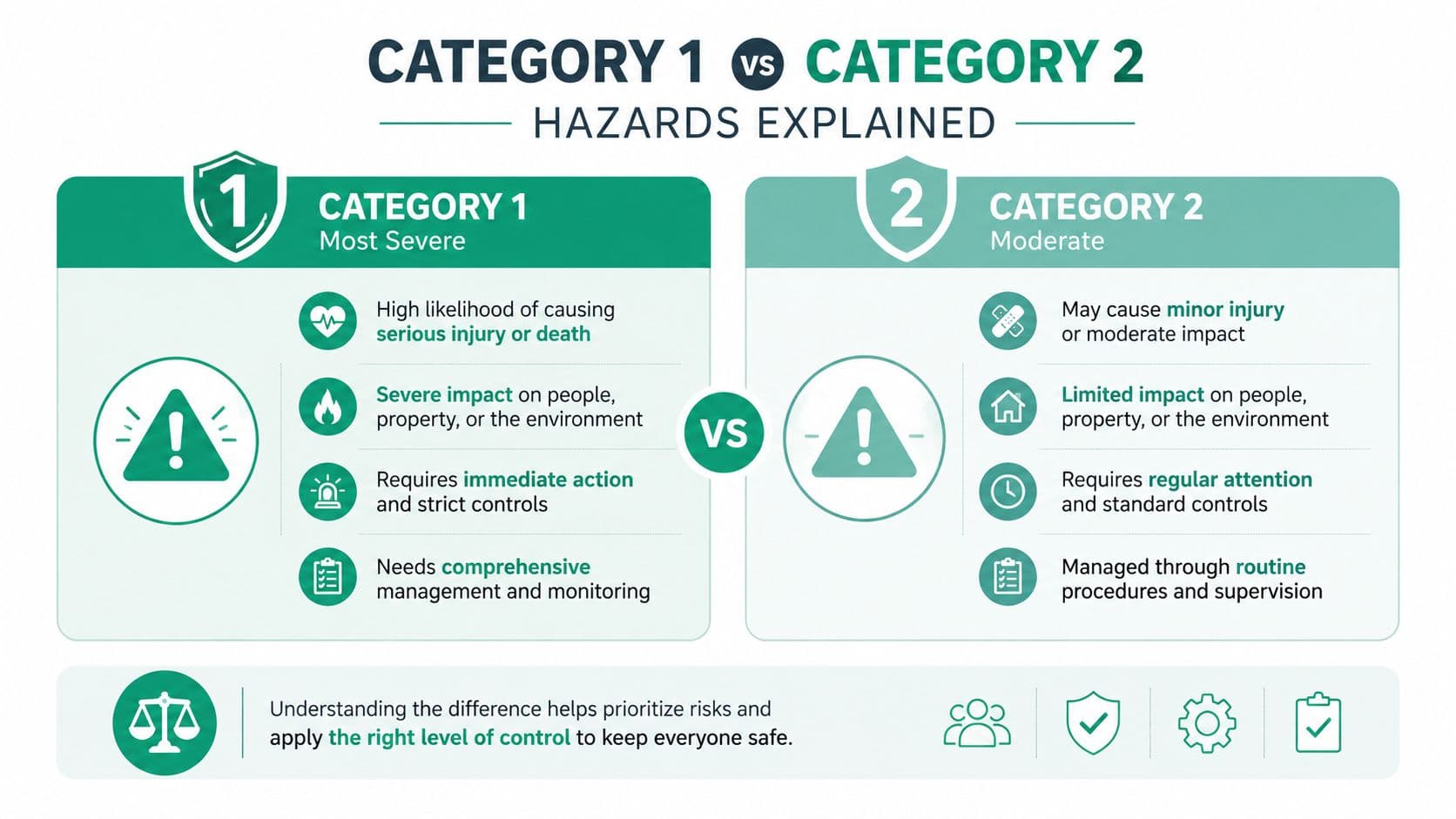
A Category 1 finding often gives stronger support for enforcement because the council is expected to act. A Category 2 finding may still be useful evidence in a disrepair claim, especially where the problem has been reported repeatedly, affects daily life, or is getting worse. Category 1 usually means greater urgency. Category 2 still means the home has a recognised hazard.
Common Hazards in Council and Housing Association Homes
Most tenants do not describe their situation in HHSRS language. They describe what is happening in the flat or house. The child's room will not dry out. The boiler keeps failing. Water runs down the kitchen wall when it rains. Those everyday problems often sit behind the hazard labels.
Damp, mould, and leaks
A common pattern is condensation on windows, mould behind furniture, and a musty smell that never goes away. Another is a roof leak or pipe leak that keeps walls wet. The risk may include breathing problems, irritation, damage to belongings, and a home that cannot be used properly. A landlord should usually be investigating the source of the moisture, repairing leaks, improving ventilation where needed, and treating damaged surfaces properly rather than painting over mould.
Cold homes and broken heating
Some tenants live with radiators that barely work, storage heaters that fail, or boilers that cut out repeatedly. In winter, that can make bedrooms hard to sleep in and bathrooms uncomfortable or unsafe to use. The hazard here is often excess cold. The repair response may involve fixing or replacing the heating system, addressing draughts, or dealing with related defects such as damaged windows.
Unsafe electrics and overloaded living
A tenant may notice sockets sparking, power tripping, exposed wiring, or an old fuse box that keeps causing problems. Electrical hazards can be serious because the risk includes shock, burns, or fire. Landlords should usually arrange inspection and repair by a qualified contractor where electrical safety is in question.
If a defect affects how a room can safely be used, that often points to a hazard rather than a minor inconvenience.
Stairs, floors, and structural dangers
Loose banisters, broken steps, rotten floorboards, and cracked surfaces can create a risk of falling or injury. These problems are easy to normalise because they become part of daily life. Hazards often show themselves through ordinary routines. Walking downstairs, plugging in a kettle, or putting a child to bed should not carry avoidable risk.
What Happens When a Landlord Does Not Act
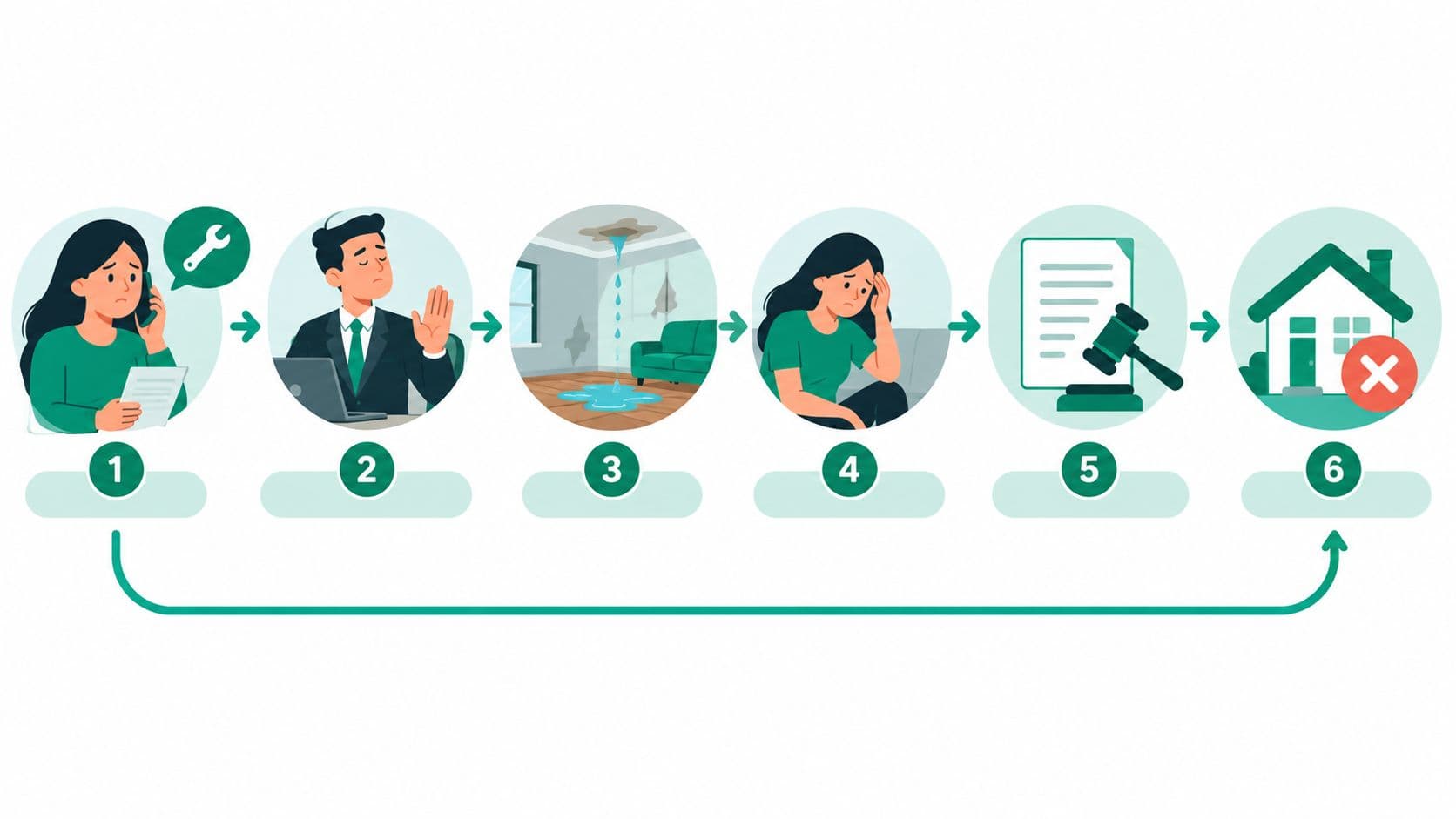
You report black mould in the bedroom. A contractor visits, wipes a patch, and leaves. Two weeks later, it is back. The heating still fails at night, the windows still drip with condensation, and the repair status says completed.
That is the point where many tenants start to wonder what HHSRS means in real life. It gives the council a way to look at the condition of your home as a health and safety risk, not just as a delayed repair. That can turn "the landlord has been slow" into "there is a hazard in the property that may need formal action."
Start by making notice clear
A landlord usually needs to know about the problem before you can fairly say they failed to act. The clearest way to show that is written notice. An email, portal message, letter, or text helps create a timeline. Keep a simple record of:
- When you reported the problem
- How you reported it
- Who received it
- Any job or reference number
- What response was promised
- Any missed visits or failed repairs
Use the complaints process if repairs stall
If reports are ignored, closed too early, or handled with temporary fixes that do not solve the cause, make a formal complaint to the landlord. A complaint gives the landlord another chance to put things right, and it shows the problem is no longer a routine repair issue.
Ask environmental health to inspect
If the landlord still does not act, the local authority environmental health team may inspect the property. Their role is different from the landlord's repair team. They look at risk. If the inspector sees conditions that amount to a serious hazard, the council may decide the landlord should not be left to deal with it in their own time.
- Serving an improvement notice: a formal notice telling the landlord what work must be done
- Taking emergency action: where there is an immediate serious risk
- Restricting use of part of the home: in more severe cases
- Using the inspection report as evidence: if the dispute later becomes a disrepair claim
A Category 1 hazard usually calls for stronger action because the risk is more serious. A Category 2 hazard may still lead to action, but the council has more choice about whether to intervene.
Damp and mould now carry more urgency in social housing
For council and housing association tenants, serious damp and mould should be treated with much greater urgency than before. Awaab's Law has increased the pressure on social landlords to investigate quickly, make emergency risks safe, and carry out repair work within set timeframes where the law applies. A landlord should not treat serious damp and mould as a cosmetic issue or keep offering short-term clean-downs while the underlying defect continues.
Other routes if the landlord still fails to act
Sometimes the problem is not only the repair itself, but the way the landlord handles the complaint. In those cases, the Housing Ombudsman may be relevant for social housing complaints about poor complaint handling or unreasonable delay. If the condition of the property has caused loss, damage, or harm, and the landlord had notice but did not put matters right within a reasonable time, legal advice may also help.
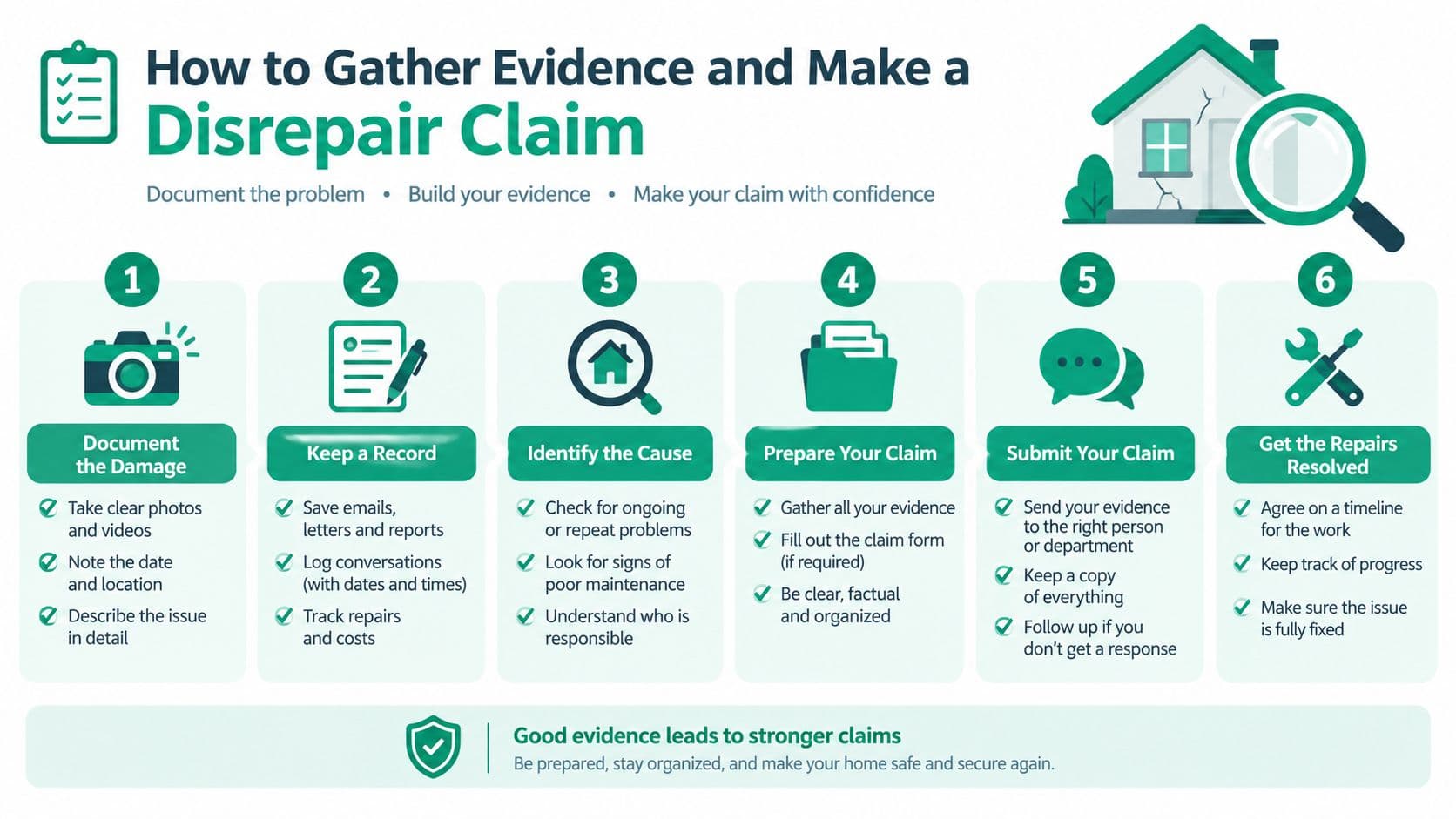
How to Gather Evidence and Make a Disrepair Claim
A strong disrepair case is usually built from ordinary records kept carefully over time. The aim is not to produce perfect legal paperwork. The aim is to show what the problem is, when the landlord knew, and how the condition affected the household.
- Repair reports: keep copies of emails, portal messages, letters, and text confirmations. If a report was made by phone, note the date, time, and name of the person spoken to.
- Photos and videos: dated images help show spread, recurrence, and failed repairs. A single photo rarely tells the full story. A timeline usually does.
- Medical evidence where relevant: if symptoms may be linked to the home, a GP or hospital record can help explain the impact. It does not guarantee any outcome, but it can strengthen the picture.
- Inspection records: an environmental health report or housing condition survey can be particularly useful where the landlord disputes the seriousness of the problem.
Make the complaint readable and specific
- What the defect is
- When it was first reported
- What has happened since
- How it affects the household
- What repair action is still needed
Keep the evidence in date order. That makes it easier for an ombudsman, council officer, or solicitor to follow the story without guessing what happened first.
When to seek claim support
Some tenants complain directly and get results. Others need help after long delays or where the disrepair has affected health, safety, or daily life. One option is to ask a regulated solicitor to assess whether you may be entitled to bring a claim. Another is a free eligibility check and, in suitable cases, referral to a regulated solicitor on a no win, no fee basis, provided you co-operate fully with the solicitor and act in good faith throughout.
Key Takeaways, Wales Differences and Next Steps
The simplest way to understand HHSRS meaning is this. It is the formal hazard assessment system councils use to judge whether conditions in a home create a health or safety risk.
- HHSRS is about risk: it does not just ask whether something is broken. It looks at the risk of harm that condition creates.
- Category 1 is the serious band: in England, that level triggers a duty on the local authority to take enforcement action.
- Category 2 still matters: it can still support complaints and disrepair evidence even where the hazard is assessed as less severe.
- Everyday issues can fall within it: damp, mould, leaks, heating failure, unsafe electrics, and unsafe stairs are all the kinds of conditions tenants commonly face.
- Evidence matters: reports, photos, complaint records, and inspection findings often make the difference between a vague complaint and a clear case file.
A note on Wales
Wales uses the same core HHSRS framework to assess whether homes are safe to live in. The Welsh Government also publishes its own housing hazards guidance and statistics, so tenants in Wales should expect the same broad hazard-based approach, but with Welsh administration and processes around it. For the wider Welsh repair framework, see Housing Disrepair in Wales.
No article can promise that a complaint or claim will succeed. Outcomes depend on the facts, the evidence, whether the landlord had notice, and what the inspection or legal evidence shows. Still, where there is a serious unresolved problem, there may be a sensible route forward through the landlord's complaints process, environmental health, the Housing Ombudsman, or a regulated solicitor.
If your landlord has ignored a repair you reported, it is worth finding out where you stand.
Our free eligibility check takes two minutes and carries no obligation to proceed.
Frequently Asked Questions
Related guides
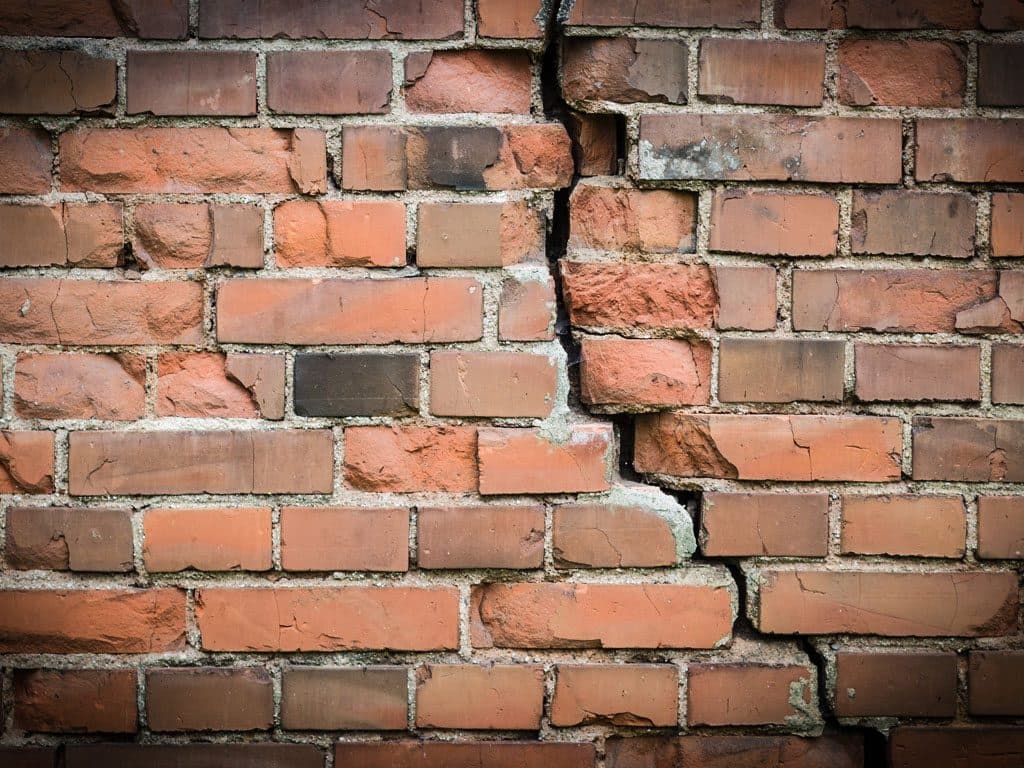
Types of housing disrepair
6 min read
A plain-English guide to common housing disrepair: damp, mould, leaks, heating, electrics, pests, and structural problems your landlord must fix.
Read guide
Council tenant's rights guide
6 min read
Understand your rights as a council or housing association tenant, including your landlord's repair duties and what to do if they fail to act.
Read guide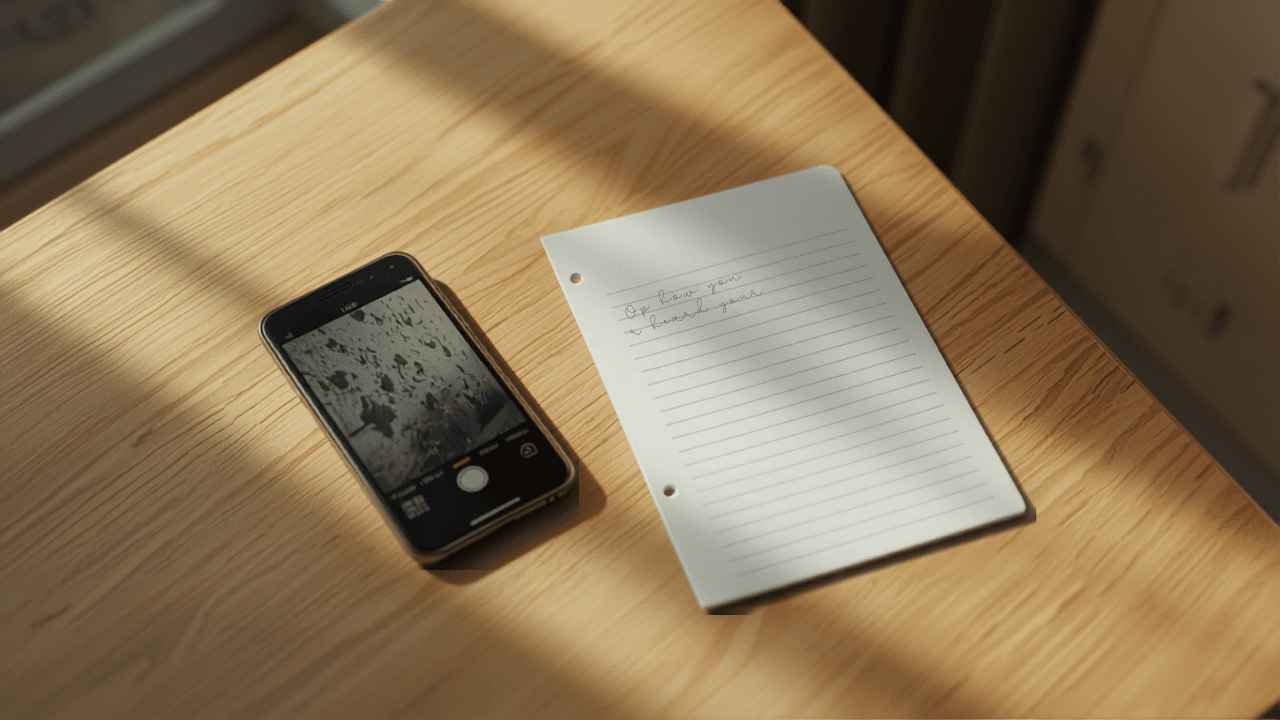
What evidence do you need for a housing disrepair claim?
6 min read
Photos, written reports, medical records and losses: evidence that strengthens a housing disrepair claim, even if you have not kept records.
Read guideNeed Help?
Council Repair Claims is an FCA-regulated claims management company and not a law firm. It can help you understand whether unresolved damp, mould, leaks, heating faults, unsafe electrics, or other disrepair may support a claim, and where suitable refer you to a regulated solicitor on a no-win, no-fee basis, provided you co-operate fully and act in good faith throughout. You can also complain directly to your landlord or use the Housing Ombudsman without charge.
Contact us on 03330 111104 or email info@councilrepairclaims.co.uk
This article is general educational information for council and housing association tenants in England and Wales. It is not legal advice, and it does not guarantee any complaint, inspection outcome, or claim result.
Content correct as of Sep 2026.