
Should council and housing association tenants pay for repairs? Who is responsible, when a recharge can apply, and how to report disrepair. This free guide for council and housing association tenants in England and Wales is published by Council Repair Claims, a regulated claims management company, not a law firm.
Should Tenants Pay for Repairs: Your Rights Explained

In most cases, structural and essential repairs are your landlord's job. Here is where the line sits, and what to do if you are asked to pay.
In most cases, no. Council and housing association tenants in England and Wales should not pay for structural repairs or essential system repairs, because those are usually the landlord's legal responsibility. The main exception is where the damage was caused by the tenant, someone in the household, or a visitor.
That answer sounds simple until real life gets involved. A ceiling starts leaking after rain. Mould keeps returning around a window. The boiler stops working in winter. Then a repairs team says it will attend, nothing happens, and the tenant is left wondering whether paying privately is the only way to get the home made safe.
The issue usually is not just whether tenants should pay for repairs. It is where the line sits between ordinary wear and tear, landlord disrepair, and damage the tenant may be recharged for.
Key Points
- In most council and housing association cases, tenants should not pay for structural repairs or essential services such as heating, water, electrics, sanitation, and hot water
- The main exception is damage caused by the tenant, someone in the household, or a visitor. Small day-to-day upkeep can also sit with the tenant
- A tenancy clause cannot usually shift the landlord's core repairing duty back onto the tenant
- The landlord generally needs notice of the problem before delay becomes an issue. Written reporting is strongly recommended
- If repairs stall, use the landlord's complaints process, then the Ombudsman or legal advice depending on how serious the disrepair is
- Paying privately and expecting a refund later is risky if the landlord has not accepted responsibility first
If your landlord has ignored a repair you reported, it is worth finding out where you stand.
Our free eligibility check takes two minutes and carries no obligation to proceed.
Your Landlord's Legal Duty to Carry Out Repairs
The starting point in both England and Wales is the landlord's legal duty. Social landlords do not just collect rent and decide case by case whether to repair things. The law places clear obligations on them.
Under section 11 of the Landlord and Tenant Act 1985, landlords in England and Wales must keep the structure and exterior of a home in repair, and keep in repair and proper working order the installations for water, gas, electricity, sanitation, space heating, and hot water. See The Landlord and Tenant Act 1985 and the text of section 11.
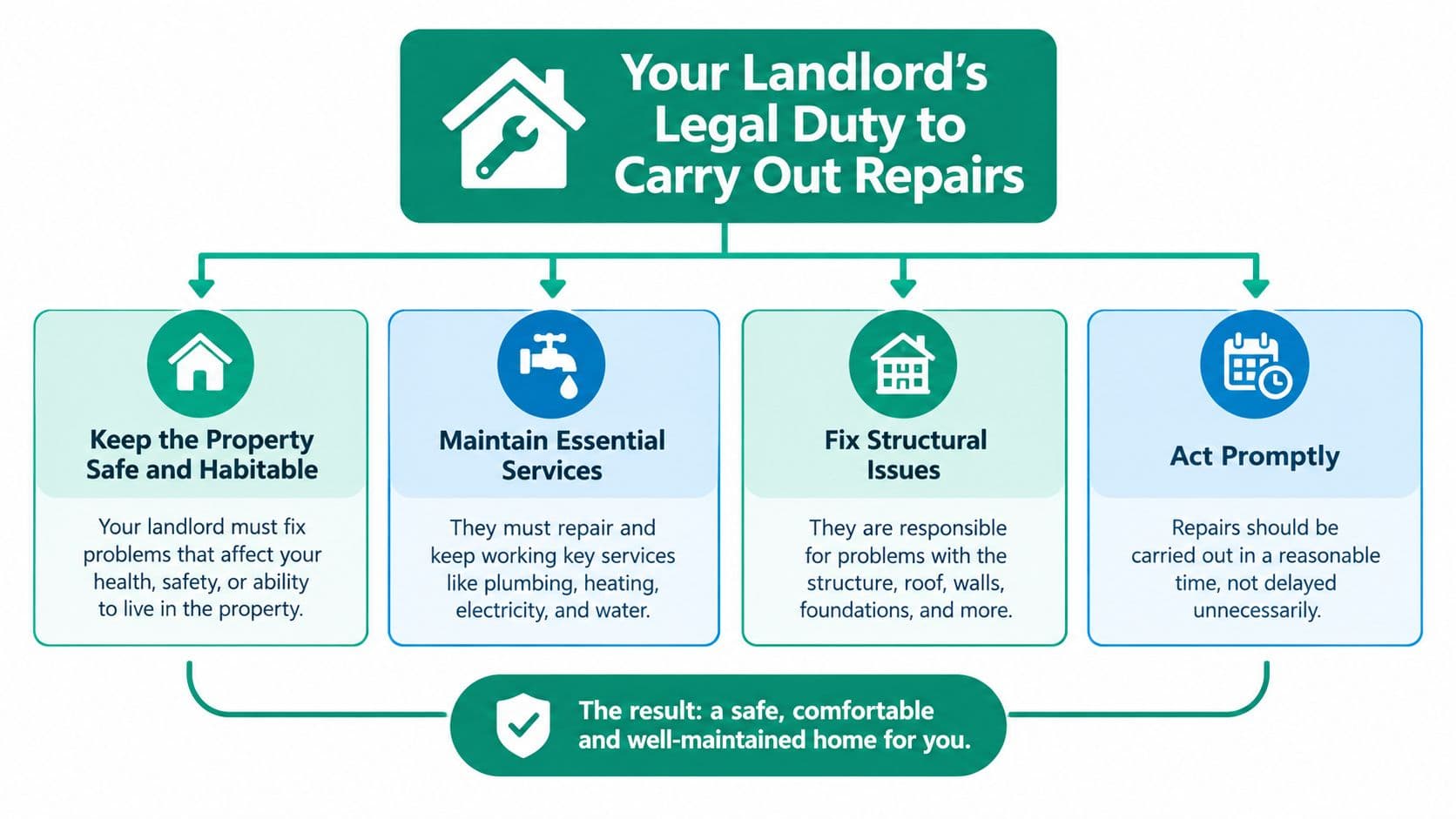
| Part of the home | Usually the landlord's duty |
|---|---|
| Structure and exterior | Roofs, walls, ceilings, windows, outside doors |
| Essential installations | Water pipes, electrics, gas supply, heating, hot water |
| Sanitation | Toilets, sinks, drains and related systems |
Why a tenancy agreement cannot simply pass this over
Some tenants worry because their tenancy agreement says they must keep the property in good order. That wording matters, but it does not usually cancel the landlord's main legal duty. Section 11 works by implying a repairing obligation into most residential tenancies. The duty exists even if the agreement does not spell it all out line by line.
A tenancy clause cannot usually turn a leaking roof, failed boiler, or unsafe electrics into the tenant's problem if the law places that repair duty on the landlord.
Repair is one issue. Fitness is another
The Homes (Fitness for Human Habitation) Act 2018 is often discussed alongside section 11 because it looks beyond whether something is technically in repair and asks whether the home is fit to live in. That matters where the problem affects health or safety, such as serious damp, mould, cold, leaks, or hazards that make normal occupation unsafe.
Notice is the trigger
A landlord usually is not expected to fix a hidden defect it does not know about. In practical terms, the clock usually starts when the tenant gives notice of the problem and the landlord has a reasonable chance to respond. Reporting matters because notice often becomes the central fact in any complaint or claim.
When Tenants May Need to Contribute to Repair Costs
Tenants often hear that the landlord repairs the property and assume that means every repair is free. Landlords sometimes focus on tenant responsibilities and make the position sound broader than it is. The more accurate answer sits in the middle.
In England, official guidance says council tenants generally should not pay for structural or service repairs caused by ordinary wear and tear, because the council is responsible for the structure and exterior of the home. The same guidance says tenants are expected to pay for damage they or their visitors cause, and to handle limited day-to-day items, as set out in the government guide on council housing repairs and maintenance. It is about cause and legal duty, not who called the repairs line first.
Three situations where a tenant may contribute
- Tenant-caused damage: if a window is broken during an argument, a door is damaged, or a visitor causes obvious damage, the landlord may recharge the cost.
- Careless or negligent damage: if water damage follows because an appliance was neglected or misused, the landlord may say the resulting repair bill should sit with the tenant.
- Small day-to-day items: some basic internal upkeep can fall to the tenant, depending on the tenancy terms and the nature of the issue.
A roof that starts leaking because of age, wear, or poor maintenance is usually a landlord repair. A broken window caused by the tenant or a visitor is usually not. A faulty electrical installation is usually a landlord issue. A cracked internal fitting caused by rough handling may not be.
The practical question is not who noticed the problem first. It is what caused it, and whether it is part of the landlord's legal repairing duty.
Emergency works can still lead to a recharge
Some councils may carry out urgent make-safe work first and deal with liability later. That can matter where a damaged door or broken window leaves the property insecure. Even where the repair is done quickly, the tenant may later receive a bill if the landlord believes the damage was deliberate, careless, or negligent. That does not always mean the recharge is correct. Tenants should check the facts carefully and dispute anything that seems unfair.
How to Report Disrepair and Build Your Evidence
Once a repair problem appears, the most useful thing a tenant can do is create a clear record. Many disputes become harder than they need to be because the issue was reported informally, no dates were kept, and later nobody agrees on what was said.
A tenant usually needs to tell the landlord about the problem before a disrepair claim can move forward, because a landlord is not usually liable until it has been put on notice and had a reasonable time to carry out the repair. Written reporting is strongly recommended because it creates evidence of notice, but verbal reporting can still count if it clearly alerts the landlord, as explained in Shelter's guidance on notifying landlords about disrepair.
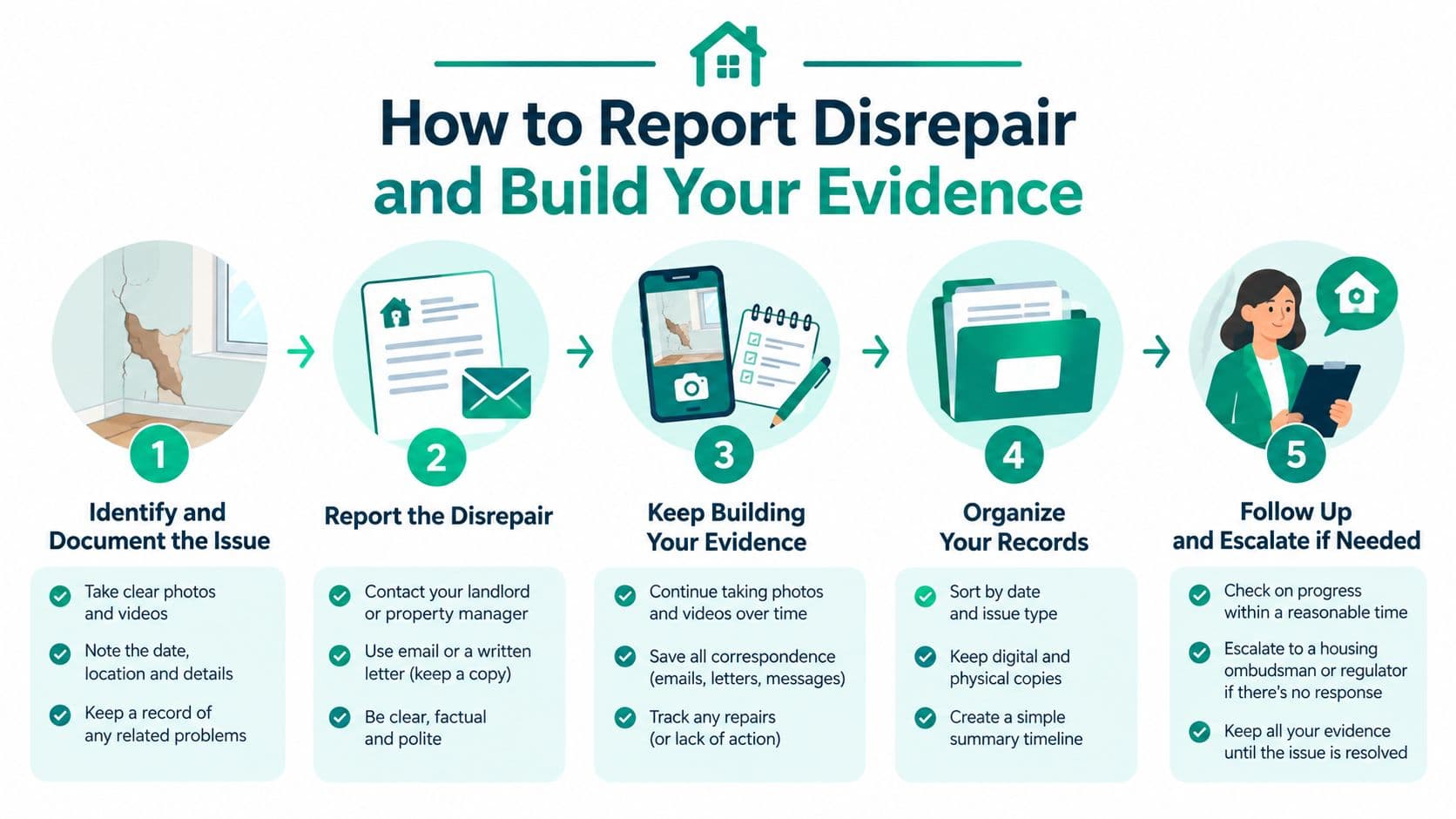
- Report the problem clearly: email is often easiest because it creates a date-stamped record. If the report is made by phone, follow up in writing the same day.
- Take dated photographs: photos should show the defect itself and the wider context. For example, mould close-up and the whole bedroom wall.
- Keep a contact log: record dates, names, appointment times, reference numbers, and what the landlord or contractor said.
- Note the effect on daily life: cold rooms, lost hot water, sleeping in another room, damaged belongings, or health impact can all matter.
- Follow up if nothing happens: a short, calm chaser email is often better than repeated calls with no paper trail.
Useful approach: keep everything in one place, such as emails, photos, appointment letters, and a simple diary. A scattered record is much harder to rely on later.
What changes under Awaab's Law
In England, Phase 1 of Awaab's Law starts on 27 October 2025 and applies to emergency hazards plus significant damp and mould hazards.
| Hazard type | What the landlord must do |
|---|---|
| Emergency hazards | Investigate and complete relevant safety work within 24 hours of becoming aware |
| Significant damp and mould hazards | Investigate within 10 working days |
| After that investigation | Provide a written summary within 3 working days of the investigation ending |
| Relevant safety work | Complete it within 5 working days of the investigation ending |
Those dates will not apply to every repair problem, but they show how seriously damp, mould, and emergency hazards are now being treated in England.
Escalation Routes When Your Landlord Will Not Act
Once a tenant has reported the disrepair and given the landlord an opportunity to respond, the next question is practical: what route is most likely to move things forward?
In Wales, council and housing association landlords are legally responsible for repairs to the structure and outside of the home, the heating system, and bathroom fittings. The landlord must be given a reasonable opportunity to carry out the repair before a complaint is brought, as set out by the Public Services Ombudsman for Wales on housing repairs. See also Housing Disrepair in Wales.
Route one: the landlord's own complaints process
This is usually the first formal step after ordinary repair reporting has not worked. It is free. It also gives the landlord a final chance to review the history, inspect again, and set out a formal position. A good complaint should attach the report history, photos, missed appointments, and the impact on the household.
Route two: the Ombudsman
If the landlord's complaint response is poor or the problem still is not put right, the Ombudsman may be the next route. It is independent and free. It can look at service failure, delay, poor communication, and complaint handling.
Route three: a solicitor or regulated claims route
Serious disrepair may justify legal advice, especially where there is ongoing damp, mould, leaks, unsafe electrics, heating failure, or harm to daily living conditions. A tenant may approach a solicitor directly, check whether Legal Aid is available, or speak to a regulated claims management company. Some solicitors handle these cases on a no-win, no-fee basis, provided the tenant co-operates fully with the solicitor and acts with integrity throughout.
| Route | Cost to start | What it can help with | Limits to keep in mind |
|---|---|---|---|
| Landlord complaint | Usually free | Internal review, repairs action, written response | The landlord reviews its own service first |
| Ombudsman | Free | Independent complaint review, service failings, delay issues | Usually expects the landlord to have had a fair chance to resolve matters |
| Solicitor-led claim | Varies by funding method | Repairs, legal remedies, and where appropriate compensation | Evidence, notice, and seriousness of the disrepair still matter |
If the disrepair is severe, a complaint and legal advice do not always have to feel like competing options. One deals with service accountability. The other may deal with legal remedies.
Real Scenarios Showing How Repair Responsibility Works
Legal rules become clearer when they are applied to ordinary situations. The same home can contain one issue the landlord must repair, another issue the tenant may be charged for, and a third issue that depends on what evidence exists.
Scenario one: damp and mould
A housing association tenant reports black mould around a bedroom window and on an outside wall. The extractor fan in the nearby bathroom has not worked for months, and water is also coming through cracked external pointing. This kind of case will often point toward landlord responsibility, because the likely cause is a mix of faulty installation and structural issues rather than simple day-to-day living. From 27 October 2025, Awaab's Law in England introduces specific timescales for emergency hazards and significant damp and mould hazards. If the landlord has clear notice and still delays, that delay can matter when the case is reviewed.
Scenario two: no heating in winter
A council tenant reports that the boiler has failed. The property has no heating and no hot water. The tenant emails the landlord, calls the repairs line, and keeps copies of both. This situation usually engages the landlord's essential systems duty. It may also raise wider questions about whether the home is fit to live in safely, especially if the delay is prolonged.
Where heating, hot water, electrics, or leaks are involved, the timing of notice often becomes one of the most important facts in the whole case.
Scenario three: tenant-caused damage
A visitor slams a window and the glass shatters. Rain then starts getting in. The landlord arranges an urgent boarding-up visit and later says it will recharge the tenant for the replacement. That outcome may be lawful if the visitor caused the damage. The urgent attendance does not automatically make it a landlord liability. The tenant should still report it promptly, explain what happened, and check whether the amount charged matches the actual work carried out.
Why the outcomes differ
- Cause decides a lot.
- Notice often decides when liability for delay begins.
- Severity affects how urgently the landlord should act.
- Evidence shapes whether a complaint or claim can be proved.
What to Do Next and How to Move Forward
The clearest answer is still the one many people need to hear first: in most social housing cases, tenants should not pay. Structural problems, outside defects, heating, water, electrics, sanitation, and hot water usually sit with the landlord, not the tenant. That remains true even if a tenancy agreement contains broad wording about keeping the home in good order.
- Check what the problem is: if it affects structure, exterior, heating, water, electrics, sanitation, or hot water, it is more likely to be a landlord repair.
- Confirm that notice has been given: written notice is best, but a clear verbal report can still matter.
- Pull together evidence: photos, letters, emails, appointment records, and a short impact diary often make the difference.
- Use the formal complaints route if repairs stall: this creates another written trail and often produces a final landlord position.
- Consider outside help where appropriate: the Ombudsman may help with service failures. A solicitor may help where the disrepair is serious and legal remedies are being considered.
Paying privately is often risky
Tenants sometimes think paying for the repair themselves will solve everything and the landlord will refund them later. That can happen in some situations, but it is not something to assume. If liability has not been accepted, private payment can create a new dispute about reimbursement.
A calm paper trail usually helps more than a hurried private repair bill that nobody agreed to in advance.
Where the disrepair is serious and the landlord has been told but has not acted reasonably, the tenant may be entitled to explore a legal claim. That does not guarantee an outcome, and it does not mean every repair problem becomes a compensation case. It does mean there may be options beyond repeated chasing.
If your landlord has ignored a repair you reported, it is worth finding out where you stand.
Our free eligibility check takes two minutes and carries no obligation to proceed.
Frequently Asked Questions
Related guides

Landlord responsibilities
6 min read
What your council or housing association landlord must legally repair, how quickly they must act, and what to do if they ignore your reports.
Read guide
The Landlord and Tenant Act 1985
5 min read
Section 11 of the Landlord and Tenant Act 1985 requires your landlord to keep your home in good repair. What this means for council tenants.
Read guide
What evidence do you need for a housing disrepair claim?
6 min read
Photos, written reports, medical records and losses: evidence that strengthens a housing disrepair claim, even if you have not kept records.
Read guideNeed Help?
Council Repair Claims can help you understand whether unresolved damp, mould, leaks, heating failures, unsafe electrics, or structural defects may support a claim, and where appropriate refer suitable cases to a regulated solicitor on a no-win, no-fee basis, provided you co-operate fully with your solicitor and act in good faith throughout. You are not required to use this service. You can also complain directly to your landlord or contact the Ombudsman for free.
Contact us on 03330 111104 or email info@councilrepairclaims.co.uk
This article is general information only and is not legal advice. Housing disrepair cases depend on the facts, the evidence, and the law in England or Wales. No outcome can be guaranteed.
Content correct as of Sep 2026.