
How to report housing association repairs, build a record, and escalate through complaints, the Ombudsman, or legal advice. This free guide for council and housing association tenants in England and Wales is published by Council Repair Claims, a regulated claims management company, not a law firm.
Housing Association Repairs: How to Report and Escalate

Reporting a repair and proving it was reported are not the same thing. Here is how to build a record from day one, and what to do if nothing happens.
A lot of tenants are in the same position right now. A leak was reported weeks ago, mould keeps coming back, someone at the housing association said it would be logged, and nothing useful seems to happen.
The hard truth is that reporting a repair and proving that it was reported are not the same thing. That gap often decides whether a complaint goes anywhere, whether the Housing Ombudsman can help, and whether a disrepair claim has the evidence it needs.
Landlords in England and Wales do have repair duties. Tenants usually get better results when they stop relying on phone promises and start building a record from day one. Calm, organised evidence beats repeated chasing every time.
If you rent from a council, the same practical repair process is in how to get council property repairs fixed.
Key Points
- Reporting a repair and proving it was reported are not the same thing. Written notice is strongly recommended because it creates a record
- Keep an evidence trail from day one: photos, emails, reference numbers, appointment dates, and the names of staff you spoke to
- Use the landlord's repair process first, then a formal complaint if the response is poor, missed, or only a temporary fix
- The Housing Ombudsman expects complaints to be raised within 12 months of the issue arising, so do not leave escalation too late
- In England, Awaab's Law from 27 October 2025 sets deadlines for emergency hazards and significant damp and mould. Those statutory deadlines do not apply in the same way in Wales
- No outcome can be guaranteed. A complaint or claim depends on notice, the condition of the home, and what the landlord did after being told
If your landlord has ignored a repair you reported, it is worth finding out where you stand.
Our free eligibility check takes two minutes and carries no obligation to proceed.
Reporting Repairs Effectively to Your Landlord
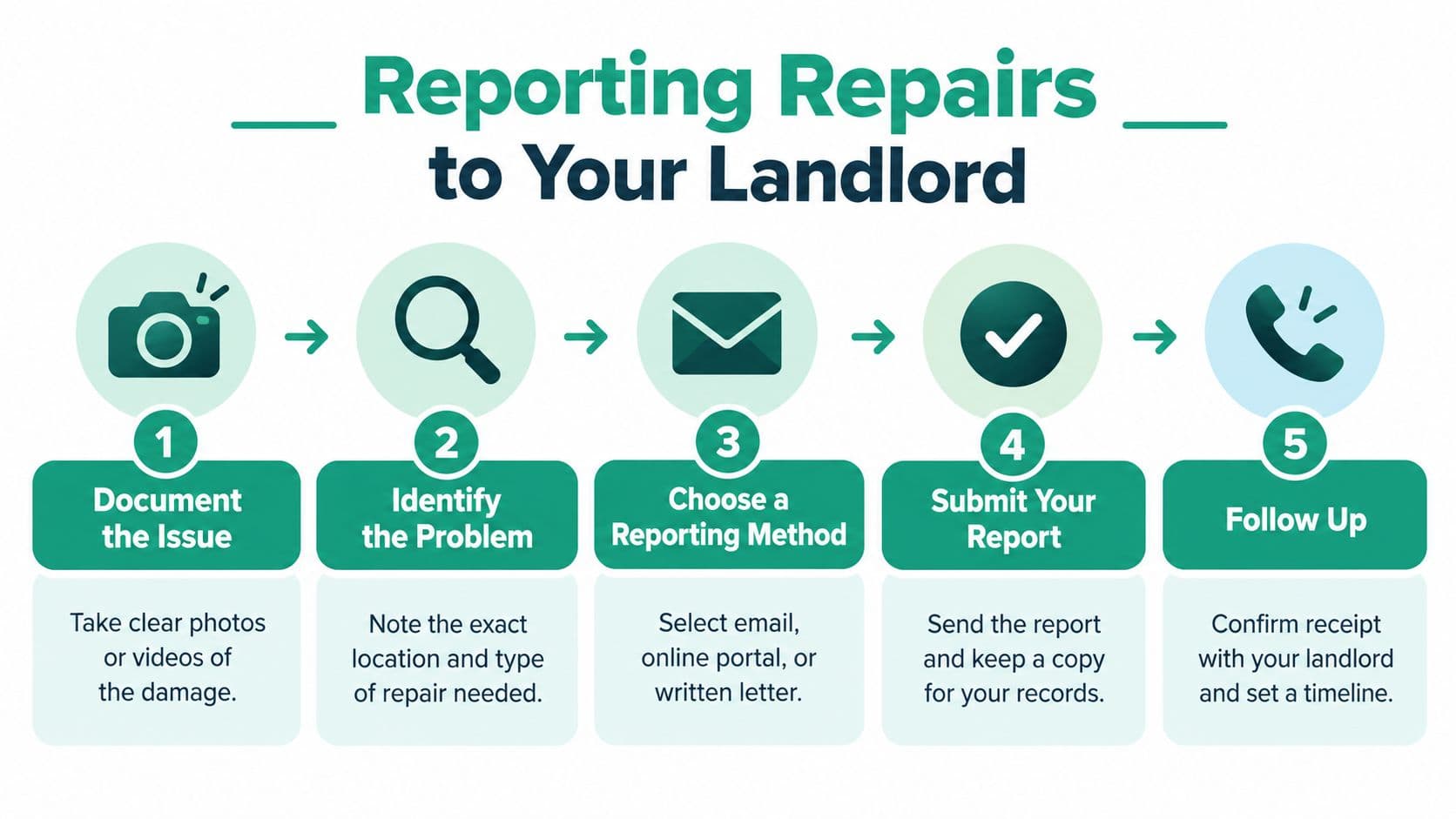
The first report matters more than most tenants realise. It does not need legal language. It needs facts the landlord cannot easily misunderstand.
Written reporting is the safest route. Email is usually easiest because it gives a time stamp and lets you attach photos. An online repairs portal can also help if it gives a reference number. A letter works too, as long as a copy is kept. Verbal reporting can be enough to notify a landlord, but on its own it often leaves you arguing about what was said and when.
What to include in the first report
- The exact problem: say what is wrong in plain English. For example, water coming through the bedroom ceiling, black mould on the external wall, a boiler not working, or a loose socket in the kitchen.
- The exact location: identify the room, wall, window, ceiling, pipe, radiator, or fitting affected.
- When it started: give the date if known, or the closest estimate.
- What impact it is having: mention loss of heating, unusable rooms, damaged belongings, a strong damp smell, or effects on health.
- What access is available: offer times for inspection or repair if possible.
Keep proof from day one
The Housing Ombudsman found that 72% of substandard-living-conditions complaints were linked to missing records, poor diagnosis, delays, and weak quality assurance, which is why dated photos and correspondence matter, according to the Annual Complaints Review 2025-26. Many cases become difficult because the record is weak, not because the defect is hard to spot.
Save screenshots of online reports, confirmation emails, missed appointment messages, and any temporary repair notes. Those details often show the pattern more clearly than a long complaint letter.
A simple reporting method that works
- Use one main channel: email or the repairs portal is usually best.
- Attach evidence at the start: photos taken over time are stronger than one photo taken late.
- Ask for a reference number: that number connects later complaints to the original notice.
- Log phone calls separately: note the date, time, team, and what was said.
- Follow up briefly: a short chasing email is better than starting from scratch each time.
Practical rule: if it is not written down, saved, dated, or photographed, it may be much harder to rely on later.
Understanding Repair Timescales and Legal Standards
Tenants often get told to allow some time without anyone saying how much time is reasonable. Clear standards matter because they show when delay becomes unacceptable.
The biggest change in England is Awaab's Law. It creates specific legal timeframes for serious hazards in the social rented sector. Awaab's Law applies to social landlords in England from 27 October 2025, as set out in the government's Awaab's Law guidance.
| Hazard category | Required action timeframe |
|---|---|
| Emergency hazards | Within 24 hours |
| Significant damp and mould hazards | Within 5 working days after the investigation ends |
That does not mean every repair has the same deadline. Routine repairs still depend on the landlord's policy, the tenancy terms, and the nature of the defect. Ask two direct questions: is this being treated as an emergency or a routine repair, and what is the target date for inspection and completion?
England and Wales are not identical
Awaab's Law is being introduced for social landlords in England. Tenants in Wales should not assume the same statutory deadlines apply in the same way. Welsh social landlords still have repair duties, but the legal route and enforcement framework may differ. See Housing Disrepair in Wales.
You do not need to argue the law in technical language. It is enough to ask the landlord to confirm the repair category, the inspection date, the completion target, and the reason for any delay.
Escalating Unresolved Issues Through Formal Complaints
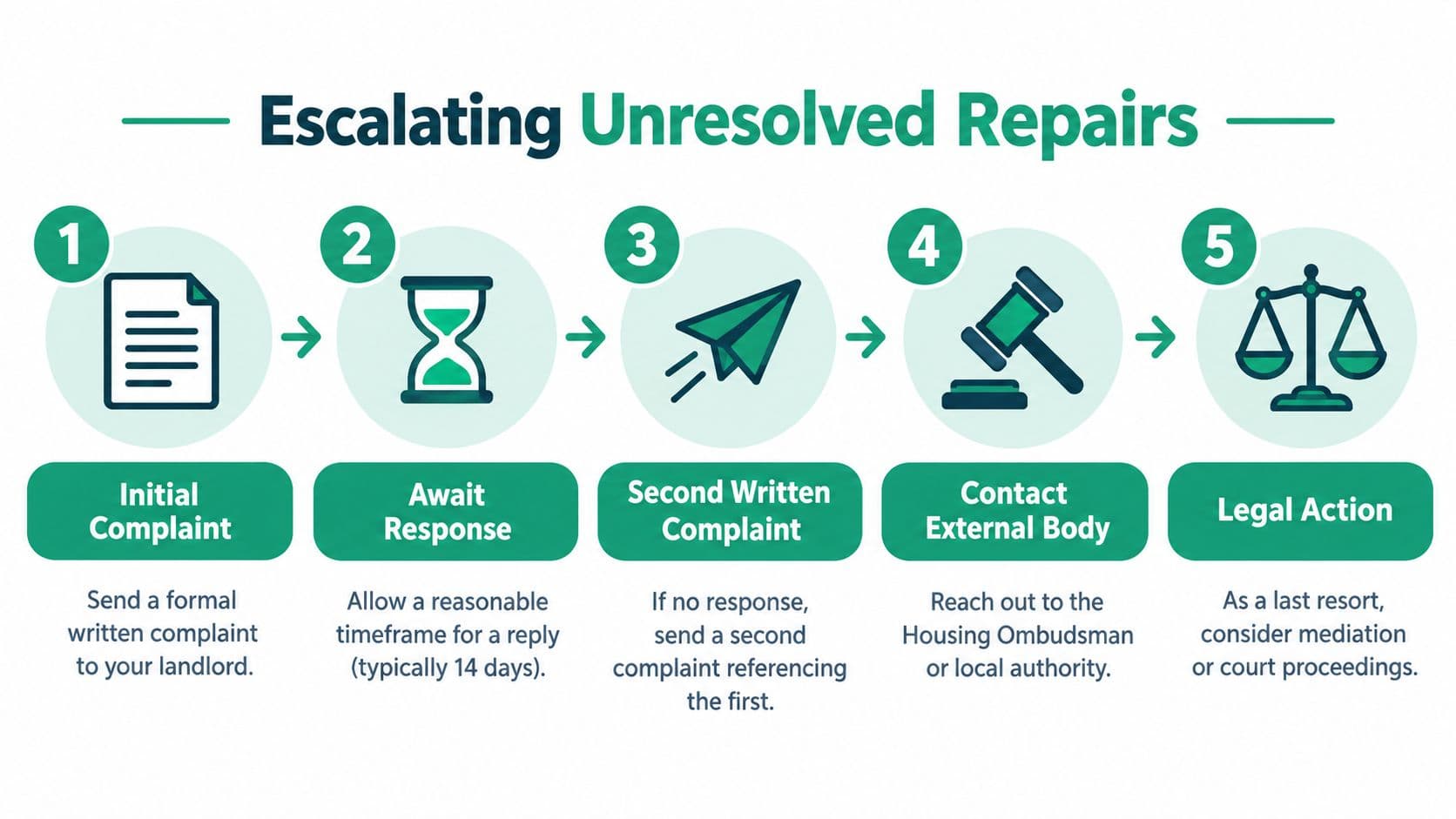
When reports go nowhere, the next step is a formal complaint, not another emotional phone call. Complaints create a second record, and that record focuses on service failure rather than just the repair defect itself.
In 2025-26, the Housing Ombudsman upheld 62% of complaints. It also found that responsive repairs appeared in 80% of determinations, with over 75% of damp and mould complaints upheld, according to the Housing Ombudsman reports. Complaints about repairs are central to the system.
What a good complaint should say
- The original repair report: give the date and reference number.
- What went wrong afterwards: delay, missed visits, temporary fixes, no diagnosis, no update.
- The current position: say whether the defect is ongoing and whether conditions are getting worse.
- What outcome is wanted: inspection, a full repair, a timetable, a complaint response, and consideration of compensation where appropriate.
Use the landlord's official complaints route where possible. If the complaint is not logged properly, the landlord may later say it was only a service request.
Timing matters
The Housing Ombudsman says tenants should complain as soon as they become aware of the issue and must raise the complaint within 12 months of the issue arising, as set out in the Housing Ombudsman resident guidance. Leave it too long and the Ombudsman may decide not to investigate.
The strongest complaints usually read like timelines, not arguments.
The Ombudsman can look at whether the landlord handled the repair and complaint properly. Outcomes may include orders to carry out work, apologise, review procedures, or pay compensation. It is a free route. It works best when the evidence is tidy.
When to Consider Legal Support for Disrepair Claims
Not every housing association repair problem needs a solicitor. Some are better handled through the landlord's repair team and complaints route. Others reach the point where professional support becomes sensible, especially where there is a long-running defect, serious disruption, repeated failed appointments, poor complaint handling, damage to belongings, or a clear health impact.
| Route | Usually best for | Main trade-off |
|---|---|---|
| Landlord repair reporting and complaints | Early-stage issues and straightforward delays | Progress depends on the landlord responding properly |
| Housing Ombudsman | Service failure, delay, poor complaint handling, missed repairs | It is not the same as running a legal damages claim |
| Solicitor-led disrepair claim | Serious, ongoing disrepair with evidence and impact | It needs co-operation, documents, and formal legal steps |
Social landlords spent a record £8.8 billion on repairs in 2023-24, yet complaints about substandard living conditions increased by 474% since 2019-20, according to Housing Ombudsman commentary. Spending alone does not solve poor systems.
Legal support may help where there is enough evidence that the landlord was notified and did not respond properly. Many firms work on a conditional fee basis. In plain terms, that often means no win, no fee, provided you co-operate fully with the solicitor and act honestly throughout. Success fees and terms should always be explained before anything is signed.
When waiting is the wrong decision
- The issue is recurring: the same leak, mould, or heating failure keeps returning.
- The records are already strong: reports, photos, complaint responses, and appointments are documented.
- The impact is wider than inconvenience: rooms cannot be used, sleep is affected, or belongings keep being damaged.
No route guarantees success. Once a case has notice, evidence, and a clear pattern of delay, getting advice may be sensible rather than waiting for another broken promise.
Next Steps
Most tenants need a clear order of action. Report the problem. Preserve the evidence. Complain formally if the response is poor. Escalate before the timeline slips out of reach.
- Starting today: take dated photos, gather older messages, and make one clear written report if there is not one already.
- If the landlord has been slow: send a formal complaint that sets out the timeline and attaches key evidence.
- If there is serious disrepair: keep a simple diary of the effect on daily life, including room use, washing, heating, sleep, and any medical contact.
- If the process is stalling: consider Ombudsman escalation or legal advice rather than restarting the story with a new call handler.
Keep the file in one place. One folder, one timeline, one set of attachments. That is far more useful than scattered screenshots across several phones.
If your landlord has ignored a repair you reported, it is worth finding out where you stand.
Our free eligibility check takes two minutes and carries no obligation to proceed.
Frequently Asked Questions
Related guides

Social Housing Repairs in England and Wales - Your Rights and What to Do
7 min read
Council and housing association tenants have legal rights to repairs: what landlords must fix, how to report, and what to do if ignored.
Read guide
Housing Ombudsman explained
4 min read
The Housing Ombudsman is a free, independent service for council and housing association tenants if your landlord will not fix your home.
Read guide
What evidence do you need for a housing disrepair claim?
6 min read
Photos, written reports, medical records and losses: evidence that strengthens a housing disrepair claim, even if you have not kept records.
Read guideNeed Help?
Council Repair Claims can help you understand whether unresolved damp, mould, leaks, heating failures, or other disrepair may be suitable for referral to a regulated solicitor on a no-win, no-fee basis, provided you co-operate fully and act honestly throughout. You can also complain directly to your landlord or use the Housing Ombudsman without charge.
Contact us on 03330 111104 or email info@councilrepairclaims.co.uk
This article is general information for council and housing association tenants in England and Wales. It is not legal advice, and it does not guarantee that a complaint or claim will succeed.
Content correct as of Sep 2026.