
A claim against your council or housing association for disrepair differs from a repair request or complaint. When to act. This free guide for council and housing association tenants in England and Wales is published by Council Repair Claims, a regulated claims management company, not a law firm.
Claim Against Council for Disrepair - What It Means and When to Act
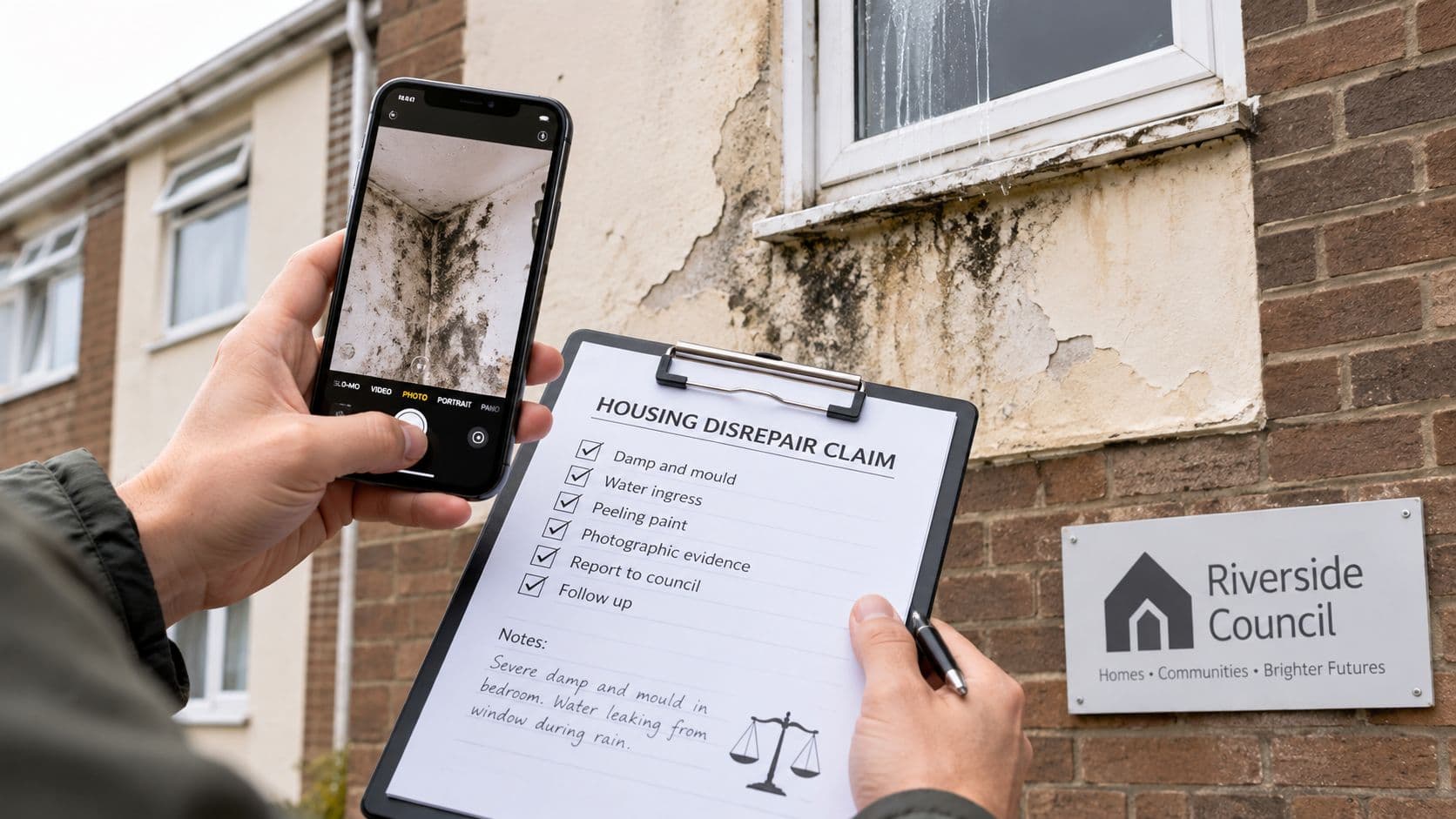
You have reported the problem more than once and nothing has changed. Here is when a repair request becomes something more formal, and what to do next.
You have reported the damp, the broken heating, the mould, or the leak to the council more than once. Nothing has changed except the problem has got worse and the frustration has grown. That is usually the point where tenants start asking a practical question: what is the difference between another repair chase and an actual claim against their council?
This guide explains that distinction clearly, sets out how to build a housing disrepair claim against a council or housing association, and covers what each step involves: including what evidence helps most, when a housing disrepair solicitor becomes the right move, and what no-win no-fee actually means for you.
Key Points
- A claim against a council or housing association for disrepair is a formal legal step that goes beyond a repair request or a service complaint. It looks at whether the landlord knew about the problem, whether they acted within a reasonable time, and whether you suffered loss or inconvenience as a result
- Your landlord must have been told about the problem before they have a legal obligation to act. Written notification is strongly recommended as it creates a clear dated record, but a claim can still proceed where a problem was clearly reported verbally
- Since October 2025, Awaab's Law requires council and housing association landlords in England to investigate emergency hazards within 24 hours and significant damp and mould within 10 working days of being notified
- A calm, well-documented approach is more effective than angry messages. The strongest housing disrepair cases are built on dates, records, and a consistent paper trail, not on the strength of feeling
- Several routes are available to you, including your landlord's formal complaints process, the Housing Ombudsman, and legal action through a housing disrepair solicitor. The right route depends on where you are in the process
- No outcome can be guaranteed. A claim against a council for disrepair may lead to repairs, compensation, or both, but only where the evidence supports it
If your landlord has ignored a repair you reported, it is worth finding out where you stand.
Our free eligibility check takes two minutes and carries no obligation to proceed.
Repair Request, Complaint, or Claim: What Is the Difference?
Understanding where you are in this process matters, because each stage has a different purpose and leads to different possible outcomes.
A repair request asks your landlord to fix a problem. It is informal and may come through a phone call, an online portal, or a letter. It gives your landlord notice of the issue and an opportunity to act. Most repair issues should be resolved at this stage.
A service complaint says that the service has been poor, delayed, or mishandled. Every council and housing association is required to have a formal complaints procedure. A complaint may produce an apology, an explanation, or faster action. It is also the required step before the Housing Ombudsman will investigate.
A housing disrepair claim is more formal. It looks at whether your landlord knew about the defect, whether they kept your home in a legal state of repair, and whether the delay or failure caused you loss, inconvenience, or harm. A successful council housing disrepair claim can result in both repairs being carried out and compensation being paid. It does not mean every case succeeds, and it should not be treated as automatic.
The practical signal that a situation has moved from a repair chase to a potential disrepair claim is usually a pattern: the problem was reported, the landlord sent someone out, a surface fix was applied, and the problem returned. At that point, the file may be ready for a formal review rather than another phone call.
Reporting Disrepair to Your Council or Housing Association
The starting point for any housing disrepair claim against a council is establishing when your landlord first knew about the problem. A claim cannot proceed if there is no evidence the landlord was told.
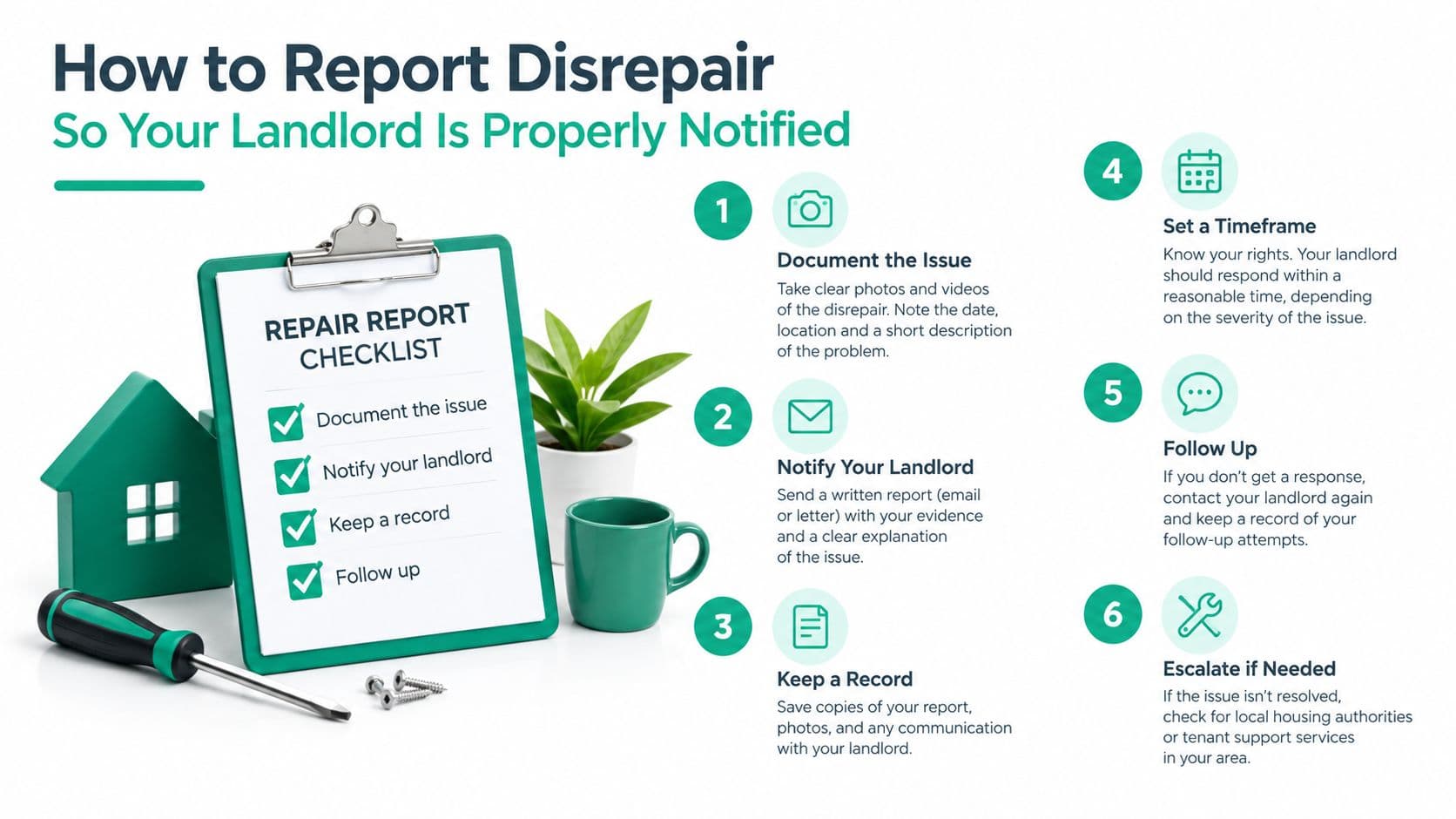
Written reporting is strongly recommended because it leaves a dated trail that is easy to prove. However, verbal notification can also count as proper notice in a council housing disrepair claim: a phone call, a visit to the housing office, or a conversation with a housing officer can all be sufficient if the date, time, and person spoken to are recorded straight away.
When you report a problem to your council or housing association, include:
- What the defect is and where it is, for example, black mould in the bedroom, no heating, leak from the ceiling above the bathroom
- When the problem first appeared
- How it is affecting your household, whether rooms are unusable, belongings are damaged, or anyone is unwell
- A request for inspection and repairs, and a response date
After reporting, keep every record. Save emails, portal screenshots, WhatsApp messages, and any texts confirming appointments or cancellations. If a contractor visits but the problem remains, note what they did and what was left unresolved. A housing disrepair claim against a council is significantly stronger when the record shows repeated notification and inadequate response rather than a single report.
If you have reported the problem verbally but not yet in writing: send an email or letter today confirming what you reported and when. This creates a formal record from the date you send it and strengthens your position considerably.
If you are still chasing the repair itself, the practical process is in how to get council property repairs fixed.
Building Evidence for a Council Disrepair Claim
A strong council housing disrepair case usually starts at home, not in a law office. The best evidence is often what tenants already have, if it is organised rather than scattered across old phones and emails.
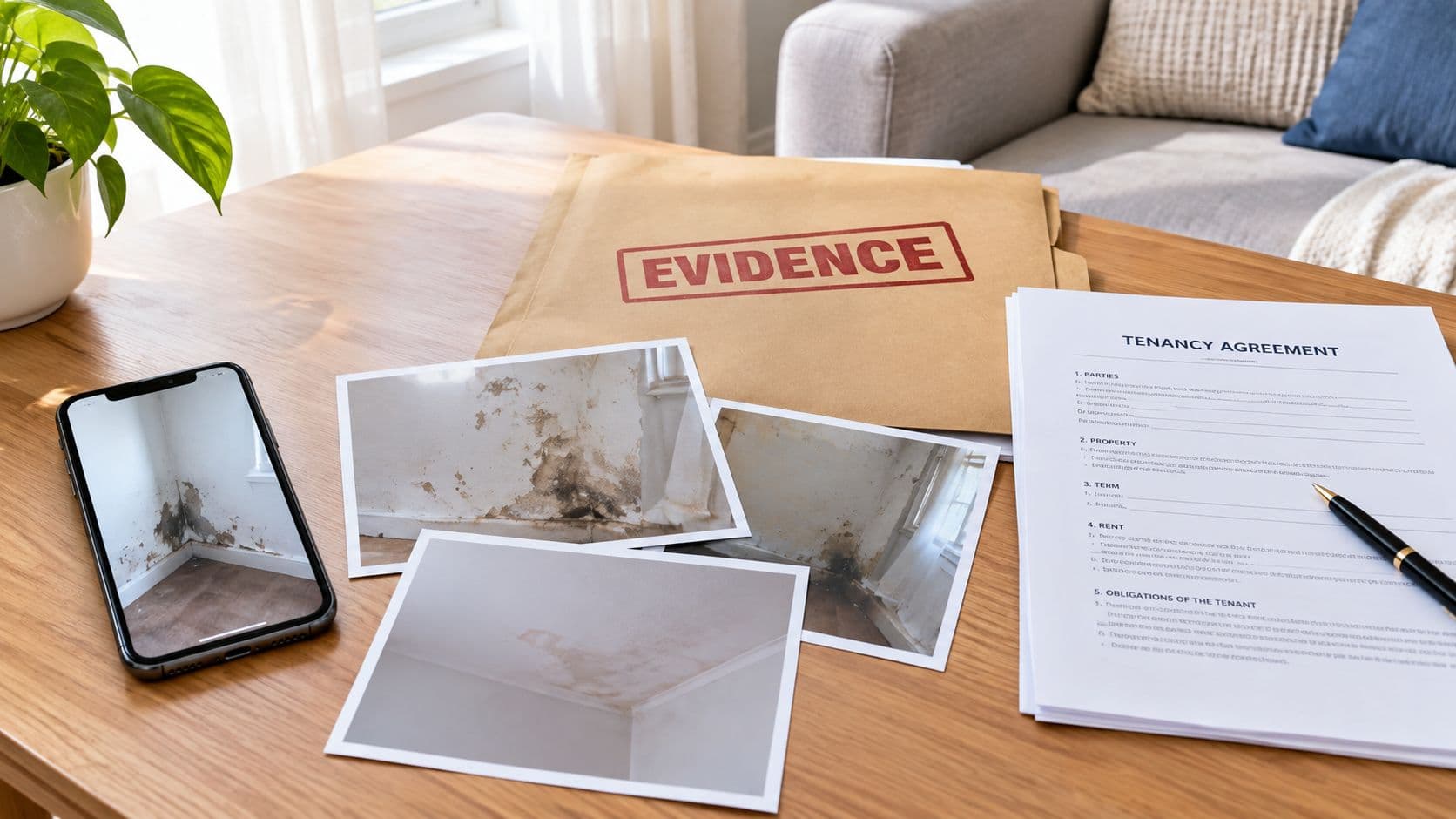
Keep your tenancy agreement, rent letters, repair emails, complaint responses, and any inspection notes together in one folder. Add dated photographs and videos showing the defect clearly. Take these regularly from the same position so any progression is visible over time.
An impact log is also worth keeping. A brief dated note each time the problem affects your sleep, health, or ability to use a room is more useful than trying to reconstruct the picture months later. If a room has become unusable, if clothing or furniture has been damaged, or if additional heating or cleaning costs have been incurred, include those details. If anyone in the household has seen a GP about symptoms linked to the housing conditions, keep copies of any relevant records.
The Housing Ombudsman's figures on council disrepair complaints show why organised records matter. In 2024-25, 72% of repairs-related findings were upheld, 80% of cases determined in 2025-26 contained a finding about responsive repairs, and 34% of repairs complaints concerned condensation, damp, and mould. Tenants with a clear paper trail consistently find it easier to progress a complaint or a formal claim.
Awaab's Law and Your Council's Legal Deadlines
Since October 2025, Awaab's Law has introduced fixed legal deadlines for council and housing association landlords in England to respond to hazards in tenants' homes.
For a claim against council that involves damp, mould, or an emergency hazard, these deadlines are directly relevant. Your council must investigate significant damp and mould within 10 working days of being notified, provide written findings within 3 working days of completing the investigation, and begin repairs within 5 working days of confirming a significant hazard. Emergency hazards must be investigated and actioned within 24 hours.
Phase 2 of Awaab's Law, due later in 2026, will extend these requirements to further hazards including excess cold, excess heat, falls, structural collapse, fire, electrical safety, and hygiene hazards.
If your council has been notified of a problem and missed these deadlines, that failure is itself evidence of a breach of their legal duty and strengthens the basis for a formal council housing disrepair claim.
Awaab's Law applies in England only. If you are a tenant in Wales, different rules apply and a separate guide covers what is relevant to you.
Escalation Routes: Complaint, Ombudsman, or Solicitor?
Once you have reported the problem and built a basic evidence file, the right route depends on where you are in the process and what you are trying to achieve.
Formal complaint to your council or housing association. This is usually the required first step and is separate from a routine repair request. Every social landlord must have a complaints procedure. Use it formally and keep all responses. A complaint may produce faster action, an apology, or a clear refusal that then allows you to escalate.
Housing Ombudsman Service. Once your landlord's complaints process is exhausted, the Housing Ombudsman is a free and independent route. It investigates how your landlord handled the situation and can order repairs, an apology, and compensation. It is particularly useful for council housing disrepair claims where the complaint process has failed. It covers England only. Where a landlord has been subject to a further investigation, that is publicly available context a solicitor may find relevant. What Is a Paragraph 49 Investigation? A Tenant's Guide explains what those investigations are.
Housing disrepair solicitor. A solicitor referral makes more sense when the situation has moved beyond a service complaint, particularly where the disrepair is serious, has affected health, or has continued despite repeated notification and formal complaints. A housing disrepair solicitor can write formally to your council requiring repairs and compensation, arrange an independent survey, and issue court proceedings if necessary. Most housing disrepair solicitors work on a no-win, no-fee basis.
When a Housing Disrepair Solicitor Becomes the Right Move
The shift from a complaint to a formal council disrepair claim usually becomes clearer after repeated reports, missed appointments, and signs that the landlord has not treated the defect as serious.
A solicitor referral is likely appropriate where:
- The same repair has been reported multiple times without being properly resolved
- The disrepair involves damp, mould, heating failure, unsafe electrics, or structural damage
- Your health or that of someone in your household has been affected
- Awaab's Law deadlines have been missed since October 2025
- You want both repairs and compensation assessed as part of the same process
Council Repair Claims is an FCA-regulated claims management company, not a law firm. It supports council and housing association tenants in England and Wales by reviewing whether the facts may justify referral to a regulated solicitor. A free assessment can help you understand whether your repair history is sufficient to take the next step, or whether more reporting and evidence is needed first.
No Win No Fee: What It Means for a Council Disrepair Claim
A no-win, no-fee arrangement means the solicitor only takes a success fee if the claim succeeds. If your housing disrepair claim against the council does not succeed, there are no fees under that arrangement.
The usual success fee is 25% plus VAT of any compensation awarded. Basic legal costs are usually sought from the landlord rather than paid upfront by you. The arrangement applies only provided you co-operate fully with your solicitor and act honestly throughout. The exact terms must be explained to you clearly before anything is signed.
A no-win, no-fee council disrepair claim does not promise a result. A proper assessment checks whether your facts, documents, and repair history are strong enough to justify a solicitor taking the matter on. An honest screening process is better than rushing into a claim with an incomplete file.
What a Successful Claim Can Achieve
A claim against a council for housing disrepair can result in repairs being carried out and, where the evidence supports it, compensation for the period during which your home was in disrepair. Compensation is not automatic and is not a fixed amount. It depends on the severity and duration of the disrepair, how it affected your daily life and health, and the financial losses you can evidence.
Several routes can lead to a financial outcome: your landlord may offer compensation during the complaints process, the Housing Ombudsman can direct payment where service failure is established, or a county court can award damages where the legal claim is made out.
What to Do Now
The simplest way to think about it is this. Make sure your council or housing association has been properly told about the problem. Build a clear record of reports, replies, and impact. Then choose the route that fits the stage of your case.
You do not need aggressive language to be taken seriously. The strongest council housing disrepair cases come from tenants who kept good notes, saved their messages, and stayed factual about what was happening at home.
If your landlord has ignored a repair you reported, it is worth finding out where you stand.
Our free eligibility check takes two minutes and carries no obligation to proceed.
Frequently Asked Questions
Related guides

What Is a Housing Disrepair Claim — and Do You Have One?
4 min read
A housing disrepair claim is a legal right to repairs and compensation if your council or housing association landlord ignored the problem.
Read guide
Making a housing disrepair claim
6 min read
Honest overview of housing disrepair claim routes for council tenants: landlord complaints, Ombudsman, solicitors, Legal Aid, or a claims company.
Read guide
What evidence do you need for a housing disrepair claim?
6 min read
Photos, written reports, medical records and losses: evidence that strengthens a housing disrepair claim, even if you have not kept records.
Read guideNeed Help?
Council Repair Claims can help you understand whether your situation may support a claim against your council or housing association and connect you with a regulated solicitor on a no-win, no-fee basis, provided you co-operate fully with your solicitor and act honestly throughout. You are not required to use our service. You can also complain directly to your landlord or contact the Housing Ombudsman for free.
Contact us on 03330 111104 or email info@councilrepairclaims.co.uk
This article is for general information only and does not constitute legal advice. No outcome can be guaranteed, and any claim depends on its specific facts, evidence, and the solicitor's assessment.
Content correct as of Sep 2026.