Learn how to identify housing disrepair claim scams, verify FCA and SRA registration, and avoid unregulated claims handlers. This free guide for council and housing association tenants in England and Wales is published by Council Repair Claims, a regulated claims management company, not a law firm.
How to Spot and Avoid Housing Disrepair Claim Scams
If your council or housing association has failed to carry out repairs, you may be entitled to compensation, but that also means you could be targeted by organisations that do not have your best interests at heart.
Knowing how to tell the difference between a legitimate claim and a scam could save you from losing money, handing over sensitive personal information, or having a genuine claim undermined.
This guide explains the tactics used by unregulated and dishonest operators, the steps you can take to verify any claims company or solicitor you are considering, and what a legitimate process actually looks like from start to finish. If you are unsure, start with our guide to choosing a housing disrepair solicitor.
Key Points
- Unregulated claims handlers operate without FCA or SRA oversight. If something goes wrong, you have no formal protection
- Any legitimate claims management company (CMC) must be authorised by the Financial Conduct Authority (FCA). Check the FCA Financial Services Register at register.fca.org.uk
- Solicitors handling housing disrepair claims must be regulated by the Solicitors Regulation Authority (SRA). Verify at sra.org.uk/consumers
- Genuine no-win, no-fee arrangements carry no upfront fees. Be cautious of any provider asking for payment before your claim concludes
- Cold callers, door-to-door canvassers and unsolicited social media messages are common routes for scam operations. You are never obliged to respond
- If you are unsure whether a claims company is legitimate, check our guide to choosing a housing disrepair solicitor before you proceed
Ready to check whether you have a valid claim?
If your landlord has failed to carry out repairs and you would like to understand whether you may have a claim, Council Repair Claims can help. We are FCA-authorised, we charge no upfront fees, and we will give you an honest assessment of your situation.
The Two Legitimate Regulated Routes
Before looking at scams, it helps to understand who is actually authorised to help you with a housing disrepair claim.
Claims management companies (CMCs) act as an intermediary. They assess your claim, connect you with a specialist solicitor and manage the process on your behalf. CMCs must be authorised and regulated by the Financial Conduct Authority (FCA). You can verify any CMC on the FCA Financial Services Register. Council Repair Claims (Ashworth & Ingram Compensation Partners Limited, FRN 1042169) is an FCA-authorised CMC.
Solicitors handle the legal work on your claim. They must be regulated by the Solicitors Regulation Authority (SRA). You can verify any solicitor or law firm at sra.org.uk/consumers.
If a company or individual offering to help you with a housing disrepair claim is neither FCA-authorised nor SRA-regulated, they are operating without oversight. If something goes wrong, you have no formal route to complain to a regulator and your money or data may be at serious risk.
How Scam Operations Target Tenants
People with housing disrepair problems are often targeted because they may be vulnerable, frustrated with their landlord and eager for a resolution. Unscrupulous operators exploit this.
Cold calling and door-to-door canvassing
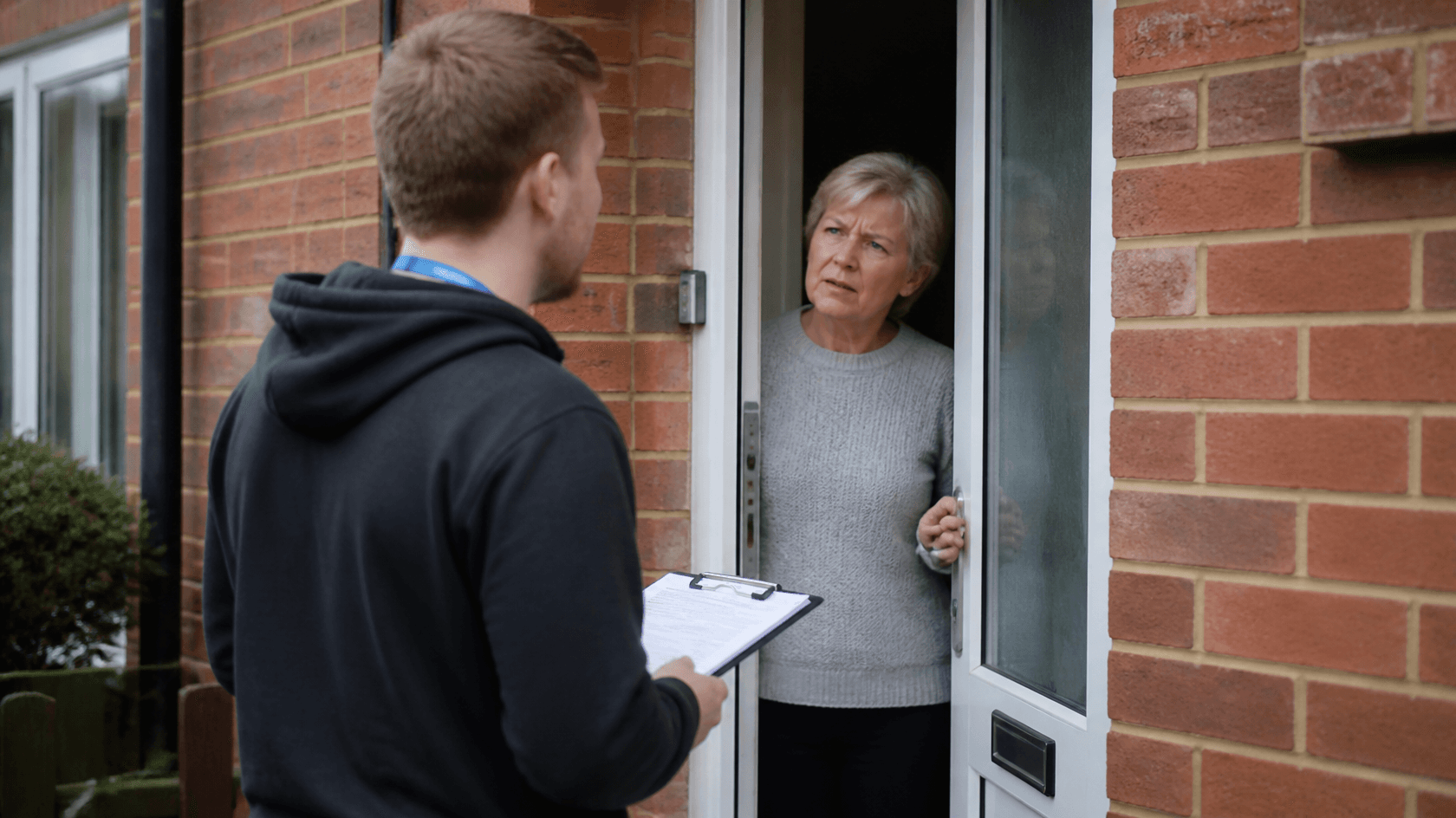
You may receive an unsolicited phone call, a knock at your door, or a WhatsApp or Facebook message claiming that you qualify for compensation under a government scheme. These approaches are a significant red flag. Legitimate regulated providers rely on their reputation and do not need to approach you without invitation.
You are never obliged to respond to unsolicited contact, and doing so does not commit you to anything. If someone comes to your door claiming to represent a housing claims scheme, ask for their company name and FCA or SRA number, then check it independently before you engage further.
Fake "government scheme" claims
Some operators claim to be part of an official government compensation scheme for social housing tenants. There is no such scheme. Housing disrepair claims are pursued through the civil courts, not through a government-administered fund. Any suggestion otherwise is misleading.
Misusing regulatory names and logos
Some scam operations display the FCA or SRA logo on their website or marketing materials without being genuinely registered. Always verify the registration number independently on the FCA or SRA website rather than relying on a logo or a claim in a letter or email.
Pressure tactics
Legitimate providers give you time to consider your options and ask questions. If a caller tells you that you must sign up immediately, that a deadline is passing today, or that your claim will be lost if you do not act now, treat this as a warning sign. A genuine no-win, no-fee arrangement does not require you to make an instant decision.
Promises of guaranteed compensation amounts
No reputable CMC or solicitor will guarantee you a specific compensation figure before reviewing the evidence in your case. Compensation in housing disrepair claims depends on the severity of the disrepair, how long it has been present, the impact on your health and daily life, and how the courts assess it. Specific figures given before any assessment are designed to create unrealistic expectations and should not be relied on.
Upfront fees
A genuine no-win, no-fee arrangement means you pay nothing upfront and nothing if your claim is unsuccessful, provided you co-operate fully with your solicitor and act honestly throughout. Be cautious of any provider that asks for an administration fee, an assessment fee or any other payment before your claim has concluded.
Data harvesting and claim farming
Some operations are not interested in running your claim at all. They are collecting your personal information to sell to third parties. You may find your details passed to multiple companies without your knowledge or meaningful consent. Always read the privacy policy of any organisation you provide personal information to, and be particularly wary of forms that appear to offer a quick eligibility check in exchange for your contact details.
How to Verify Whether a Company Is Legitimate
Before you engage with any company offering to help with a housing disrepair claim, take these steps.
- Check the FCA Financial Services Register. If the company describes itself as a claims management company, it must appear on the register. Go to register.fca.org.uk and search by company name or FRN (Firm Reference Number). Check that the registration is current, that claims management is listed as a permitted activity, and that the address matches what the company has told you.
- Check the SRA register. If the company is a solicitors' firm or describes itself as a law firm, search for it at sra.org.uk/consumers. Verify that the firm is currently authorised and that the individual solicitor you are dealing with holds a current practising certificate.
- Search for independent reviews. Look for reviews on independent platforms such as Trustpilot or Google. Be aware that reviews can be fabricated, so look for consistency across a range of dates rather than a cluster of identical five-star reviews. Check whether the company responds to negative feedback and how.
- Look at the company's history. A company that was incorporated very recently, has changed its name multiple times, or has a website with no clear address or contact information warrants extra caution.
- Do not rely on logos or claimed credentials alone. Verify any registration number you are given by entering it directly into the FCA or SRA website. A logo on a website does not confirm authorisation.
What a Legitimate Process Actually Looks Like
Understanding what the genuine process looks like makes it much easier to spot when something is wrong. With Council Repair Claims and the specialist solicitors we work with, the process is straightforward:
- You contact us and we assess your situation. This is free and carries no obligation.
- If your circumstances suggest you may have a valid claim, we connect you with a specialist solicitor.
- The solicitor reviews your case in detail and advises on your prospects.
- If you proceed, your claim is run on a no-win, no-fee basis. Provided you co-operate fully with your solicitor and act honestly throughout, you pay nothing if your claim is unsuccessful.
- Evidence is gathered, your landlord is notified, and the claim is pursued through the appropriate legal channels.
- If your claim succeeds, compensation is awarded by the court or agreed through settlement. The amount reflects the specific facts of your case.
At no stage are you pressured to make a quick decision, asked to pay upfront, or given a guaranteed compensation figure.
A Quick-Reference Guide to Red Flags
| Warning sign | What it may indicate |
|---|---|
| Unsolicited contact by phone, door or social media | Potential scam operation |
| Claims to represent a government scheme | Misleading. No such scheme exists |
| Requests upfront fees | Not a genuine no-win, no-fee arrangement |
| Guarantees a specific compensation amount | Unrealistic and misleading |
| Cannot provide an FCA or SRA registration number | Unregulated |
| Registration number does not match FCA or SRA records | Potential fraud |
| Pressures you to sign up immediately | High-pressure sales tactic |
| Asks for personal details before explaining the process | Possible data harvesting |
| No verifiable address or contact information | Significant concern |
What to Do If You Have Been Approached by a Suspected Scam
If you have been approached by a company you believe is operating without authorisation or misleading consumers, you can report it:
- FCA (for unregulated claims management companies): fca.org.uk/consumers/report-scam
- SRA (for solicitors behaving improperly): sra.org.uk/consumers/problems/report-solicitor
- Report Fraud (the national fraud reporting service, which replaced Action Fraud): reportfraud.police.uk
If you have already handed over money or personal information to a company that you now believe was operating as a scam, contact your bank immediately and report the matter to Report Fraud.
If you are renting in Wales
The legal framework for housing disrepair in Wales differs from England in several respects. Your tenancy is governed by the Renting Homes (Wales) Act 2016, and complaints about housing associations may be directed to the Public Services Ombudsman for Wales rather than the Housing Ombudsman. However, the steps for verifying whether a claims company or solicitor is regulated remain the same. Always check FCA or SRA registration before you engage with any provider.
Ready to check whether you have a valid claim?
If your landlord has failed to carry out repairs and you would like to understand whether you may have a claim, Council Repair Claims can help. We are FCA-authorised, we charge no upfront fees, and we will give you an honest assessment of your situation.
Frequently Asked Questions
Related guides

Understanding no-win, no-fee
5 min read
How no-win, no-fee housing disrepair claims work: what you pay, what happens if you lose, and free alternatives before you commit.
Read guide
The Housing Ombudsman: A Tenant's Guide
5 min read
What the Housing Ombudsman does, who can use it, how to complain and how to contact it, explained for council and housing association tenants.
Read guide
Top 10 Mistakes Tenants Make in Housing Disrepair Claims
10 min read
Housing disrepair claims can fail because of avoidable mistakes. This guide explains ten common errors and how to avoid them.
Read guideNeed Help?
We are FCA-authorised, we charge no upfront fees, and we will give you an honest assessment of your situation.
Contact us on 03330 111104 or email info@councilrepairclaims.co.uk
Council Repair Claims is the trading name of Ashworth & Ingram Compensation Partners Limited, authorised and regulated by the Financial Conduct Authority as a claims management company (FRN 1042169). This article is for general information only and does not constitute legal advice. Outcomes depend on the specific circumstances of each case.
Content correct as of Oct 2026.